

Application Engineering · Component review guide · Litian Yunde
Check the removal envelope. Original explanatory schematic; not to scale and not a product test result.
Un pannello di accesso può adattarsi perfettamente quando è chiuso ed essere comunque difficile da rimuovere. Verificare il raggio d'azione, l'accessibilità ai dispositivi di fissaggio, lo spazio libero per le mani e la presenza di cavi nelle vicinanze. Il controllo di accettazione del campione dovrebbe includere l'apertura e il rimontaggio del pannello in un assemblaggio rappresentativo dell'ambiente circostante.
Draw the service envelope
Show the panel in its closed position and the space it occupies during removal. Include neighbouring brackets, hoses and connectors. A clear opening in a two-dimensional outline does not establish a usable service path. State whether the panel is hinged, lifted straight off or moved sideways before release, and identify any sequence that depends on other components being removed.
Make fastening accessible
Show the tool approach, retained hardware and any risk of loose items falling into the equipment. Identify the mating fasteners rather than choosing them from appearance alone. For repeatedly serviced panels, agree which elements are replaceable and how wear is checked. Keep the accessibility review distinct from any structural or protective performance requirement.
Use the intended service condition for acceptance
Evaluate a representative assembly with the cables, seals and attachments present. Record whether removal can be completed using the specified tools and sequence. If protective gloves or restricted access are part of the application, include those constraints in the review. A staged tabletop photograph of the isolated panel is not a complete serviceability demonstration.
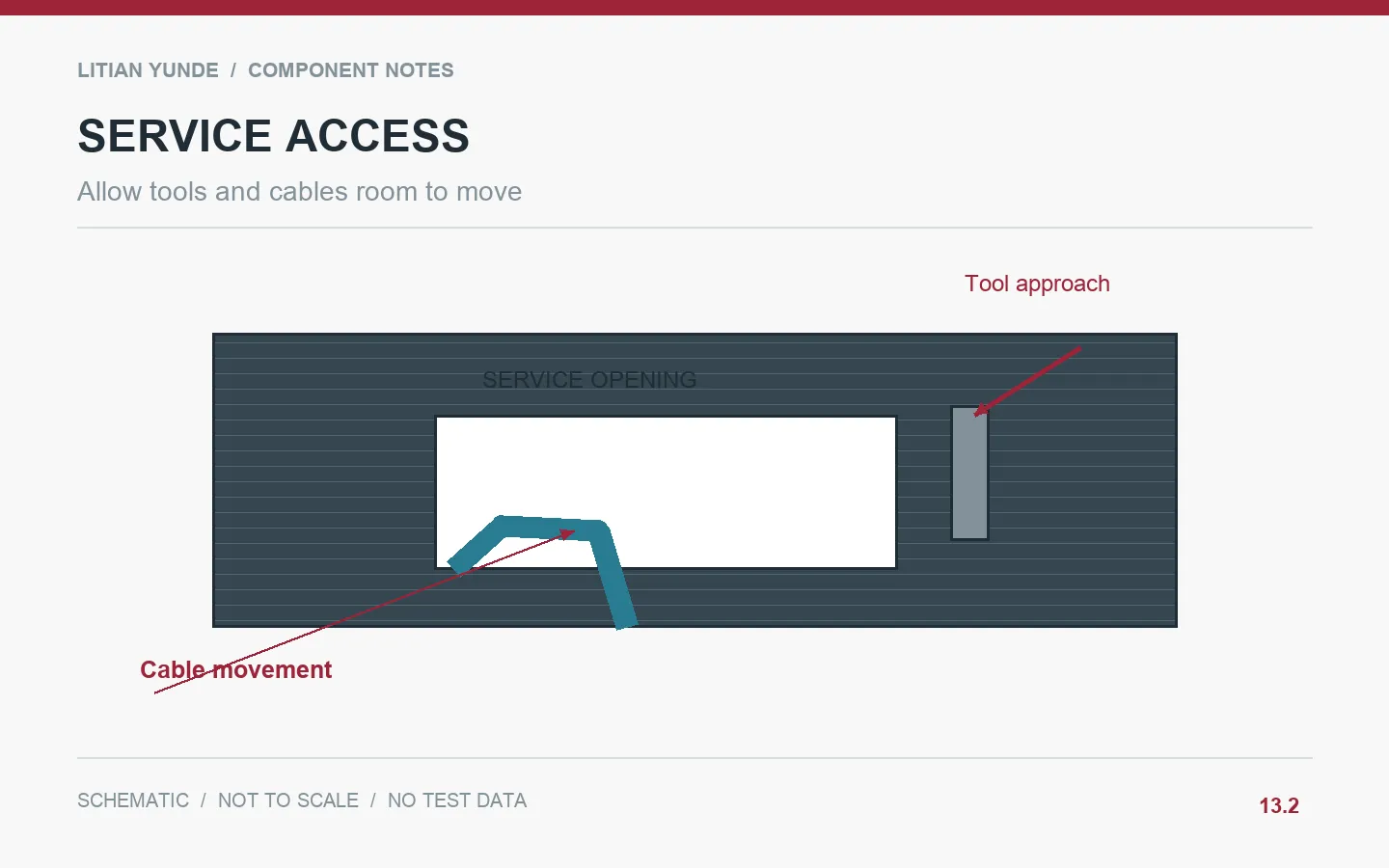
Example: a motor-control housing cover
A large opening gives good access to the electronics, but the cover collides with a nearby bracket before its locating tabs release. The team adds a removal-path drawing and revises the tab clearance. The next sample is opened and reinstalled in the surrounding assembly, with cables routed as intended. Closed fit and service access receive separate acceptance entries.
Scenario illustrativo, non un caso reale di un cliente né un risultato di produzione riportato.
Dettagli da concordare prima di effettuare l'ordine
| Articolo in recensione | Registrare per confermare |
|---|---|
| Opening sequence | Hinge, lift, slide and any prerequisite steps. |
| Swept volume | Panel movement, tool approach and hand space. |
| Surroundings | Cables, brackets, seals and retained hardware. |
| Accettazione | Representative removal and reinstallation check. |
Domande poste dagli acquirenti
Can the opening size alone prove service access?
No. The component and tool must also have a usable path through that opening.
Does a service-access check qualify a protective enclosure?
No. Protective functions require their own specifications and verification.
Nozioni tecniche e letture consigliate
Risorsa di riferimento: Hexcel: Tecnologia dei preimpregnati. La checklist del progetto e l'esempio riportati sopra costituiscono linee guida redazionali; il presente documento non certifica alcun componente Litian Yunde.
- Carbon Fiber Robot Covers: Access, Cables and Serviceability
- Metà del guscio in fibra di carbonio abbinate: piano di sostituzione e intercambiabilità
- Esplora il centro informazioni sulla fibra di carbonio
Rivedi il tuo componente con Litian Yunde
Indica la revisione del disegno, l'applicazione prevista e la questione relativa all'interfaccia o al collaudo che devi risolvere. I requisiti di costruzione e di accettazione citati sono confermati per il progetto specifico.