

Application Engineering · Component review guide · Litian Yunde
Check the removal envelope. Original explanatory schematic; not to scale and not a product test result.
An access panel can fit perfectly when closed and still be difficult to remove. Review the swept path, fastener access, hand clearance and nearby cables. The sample acceptance check should include opening and reinstalling the panel in a representative surrounding assembly.
Draw the service envelope
Show the panel in its closed position and the space it occupies during removal. Include neighbouring brackets, hoses and connectors. A clear opening in a two-dimensional outline does not establish a usable service path. State whether the panel is hinged, lifted straight off or moved sideways before release, and identify any sequence that depends on other components being removed.
Make fastening accessible
Show the tool approach, retained hardware and any risk of loose items falling into the equipment. Identify the mating fasteners rather than choosing them from appearance alone. For repeatedly serviced panels, agree which elements are replaceable and how wear is checked. Keep the accessibility review distinct from any structural or protective performance requirement.
Use the intended service condition for acceptance
Evaluate a representative assembly with the cables, seals and attachments present. Record whether removal can be completed using the specified tools and sequence. If protective gloves or restricted access are part of the application, include those constraints in the review. A staged tabletop photograph of the isolated panel is not a complete serviceability demonstration.
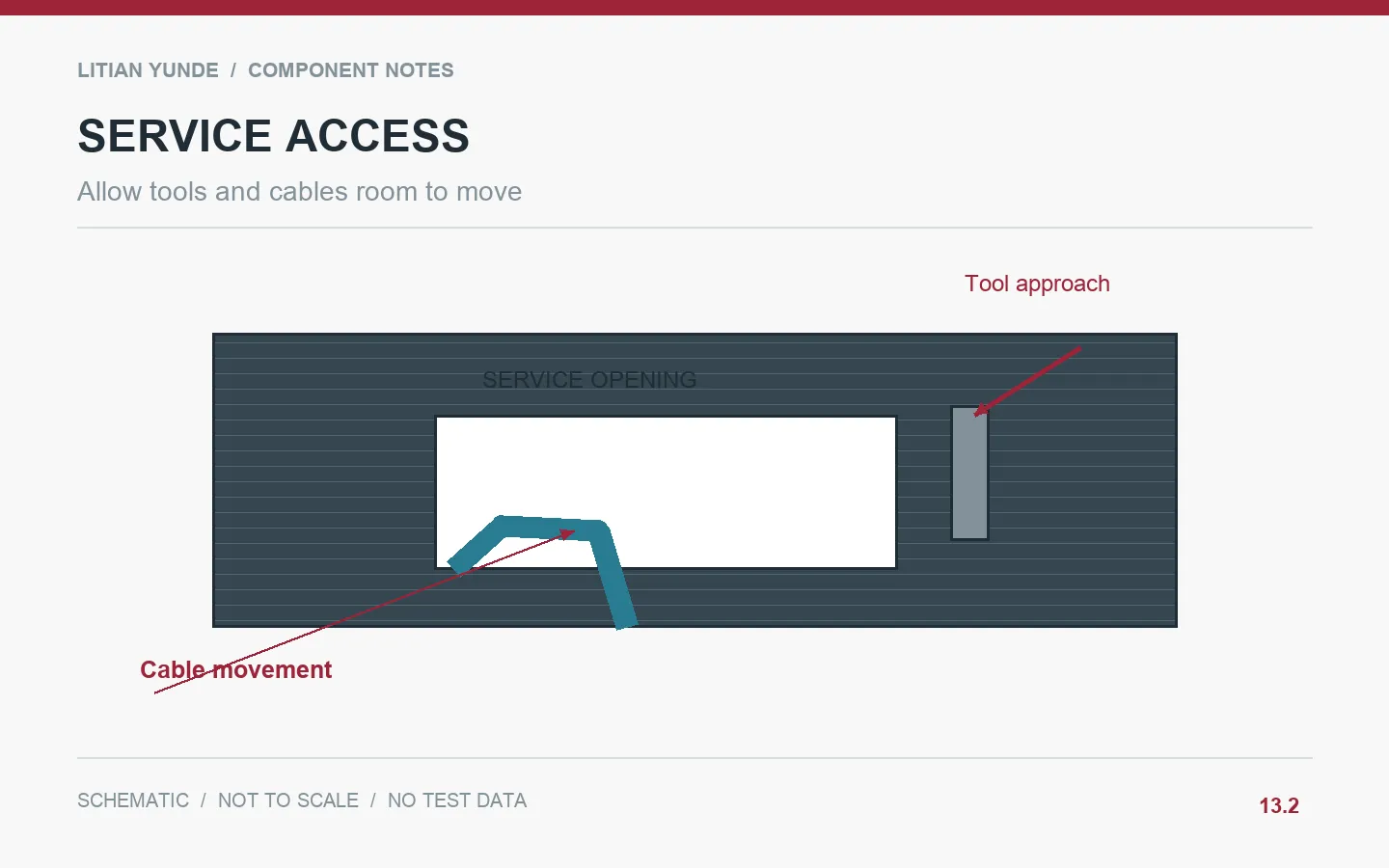
Example: a motor-control housing cover
A large opening gives good access to the electronics, but the cover collides with a nearby bracket before its locating tabs release. The team adds a removal-path drawing and revises the tab clearance. The next sample is opened and reinstalled in the surrounding assembly, with cables routed as intended. Closed fit and service access receive separate acceptance entries.
Scénario à titre d'exemple ; il ne s'agit ni d'un cas client ni d'un résultat de production avéré.
Éléments à convenir avant de passer commande
| Article à évaluer | Consigner pour accord |
|---|---|
| Opening sequence | Hinge, lift, slide and any prerequisite steps. |
| Swept volume | Panel movement, tool approach and hand space. |
| Surroundings | Cables, brackets, seals and retained hardware. |
| Acceptation | Representative removal and reinstallation check. |
Questions posées par les acheteurs
Can the opening size alone prove service access?
No. The component and tool must also have a usable path through that opening.
Does a service-access check qualify a protective enclosure?
No. Protective functions require their own specifications and verification.
Contexte technique et lectures complémentaires
Document d'information : Hexcel : Technologie des préimprégnés. La liste de contrôle du projet et l'exemple ci-dessus constituent des recommandations rédactionnelles ; ce document ne certifie pas un composant Litian Yunde.
- Capots de robot en fibre de carbone : accès, câbles et facilité d'entretien
- Matched Carbon Fiber Shell Halves: Plan Replacement and Interchangeability
- Parcourez le centre de connaissances sur la fibre de carbone
Passez en revue votre composant avec Litian Yunde
Veuillez nous communiquer la version révisée du plan, l'application prévue ainsi que la question relative à l'interface ou au contrôle que vous souhaitez voir résolue. Les exigences de construction et de réception mentionnées sont validées pour ce projet spécifique.