
Machining & Assembly · Component review guide · Litian Yunde
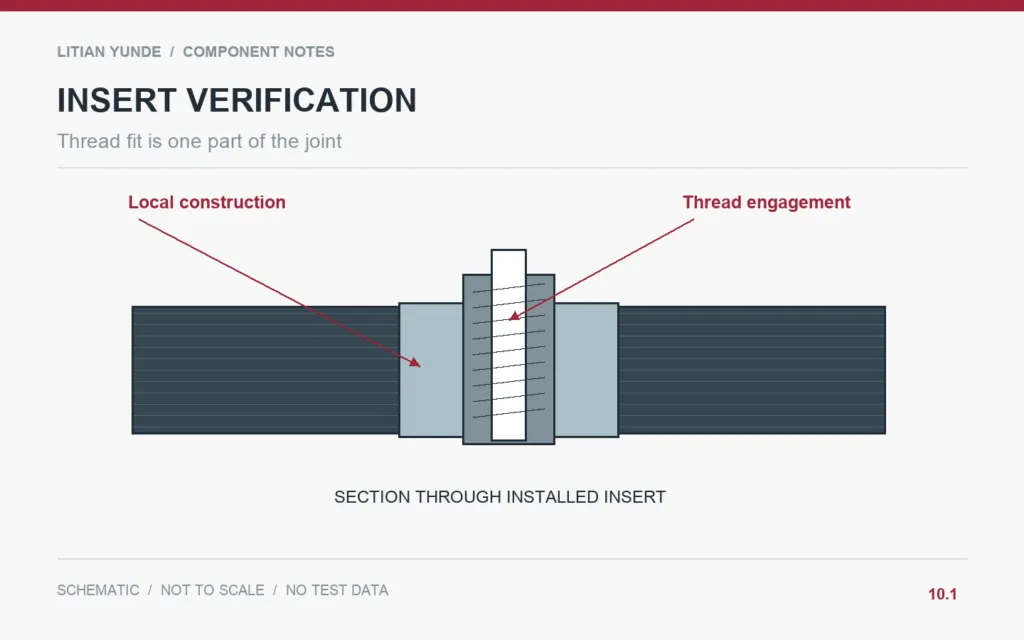
Thread fit is one part of the joint. Original explanatory schematic; not to scale and not a product test result.
Tightening torque, pull-out resistance and repeated assembly performance describe different aspects of a threaded insert. Specify which loads and service conditions matter, then agree representative tests. A thread gauge result alone does not qualify the insert’s attachment to the composite.
Define the complete insert assembly
Identify the insert, surrounding laminate or local reinforcement, installation method and mating fastener. Include thread engagement and any bearing surfaces in the drawing. A catalogue value for a metal insert does not establish the capacity of its installed composite interface. The relevant assembly includes the local part geometry and the process used to retain the insert.
Separate installation from operational loading
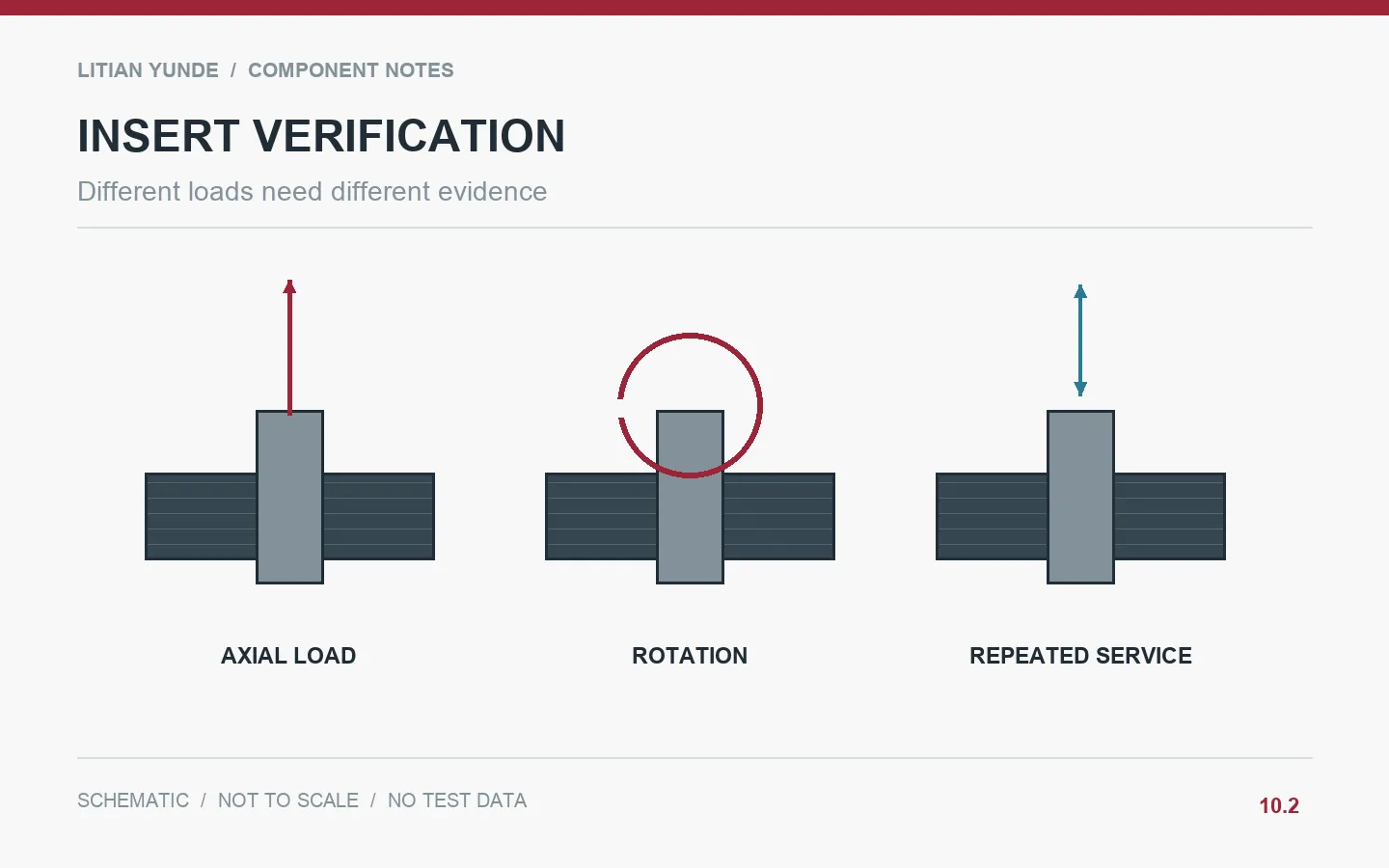
An installation torque may concern fitting the insert; a fastening torque concerns the mating screw. Neither is automatically the permitted service load. State whether the joint sees axial pull, rotation, bending or repeated removal. The responsible engineer should set the test conditions and acceptance criteria for the application rather than selecting values from a visually similar component.
Plan inspection after the relevant duty
Record thread condition, insert movement and the surrounding surface after the agreed test. If repeated servicing matters, define the representative fastening sequence and inspection points. Preserve failed samples for investigation where appropriate. A part that passes an initial fit check may still require separate testing before its intended service use.
Example: an electronics cover removed for maintenance
The cover’s inserts accept screws during initial assembly, but the product is expected to be opened repeatedly. The buyer specifies the fastener, engagement and maintenance duty, then requests a representative repeated-assembly evaluation. The report distinguishes the screw’s fit from insert rotation and local condition. It does not generalise the result to every insert size.
Illustrative scenario, not a customer case or reported production result.
Details to agree before ordering
| Review item | Record to agree |
|---|---|
| Hardware identity | Insert, screw, engagement and bearing arrangement. |
| Local construction | Drawing revision and reinforcement/installation detail. |
| Duty and load | Pull, rotation, service cycles and environment. |
| Acceptance evidence | Test configuration, outcomes and post-test inspection. |
Questions buyers ask
Does a good thread gauge check prove pull-out strength?
No. It checks a thread condition, not the installed joint’s load capacity.
Should a failed insert simply be bonded back in?
Only under an approved repair or rework instruction with appropriate reinspection.
Technical background and related reading
Background resource: Hexcel: Prepreg Technology. The project checklist and example above are editorial guidance; this reference does not certify a Litian Yunde component.
- Inserts in Carbon Fiber Parts: Define the Insert and Its Position
- Carbon Fiber Bonded Joints: Control Overlap and Bondline Geometry
- Browse the carbon fiber knowledge centre
Review your component with Litian Yunde
Share the drawing revision, intended application and the interface or inspection question you need to resolve. The quoted construction and acceptance requirements are confirmed for the specific project.