
Application Engineering · Component review guide · Litian Yunde
Follow the complete dimension chain. Original explanatory schematic; not to scale and not a product test result.
A carbon fiber component can meet its own drawing and still leave too much or too little clearance in an assembly. A tolerance stack relates the contributing dimensions to a functional gap. Include mating hardware, coatings and locating conditions, then confirm the approach with the responsible engineer.
Name the functional result first
Identify the clearance, flushness, alignment or engagement that the assembly needs. Sketch a dimension chain from the locating reference to that result. Do not start by tightening every component tolerance: some dimensions may have little effect while one overlooked interface controls the fit. The chain should include the parts actually supplied and the condition in which they are assembled.
Account for the supplied condition
Coatings, adhesive layers, washers and local pads can contribute to the assembled relationship. Specify whether dimensions describe unfinished or finished surfaces. State which features locate the component and which remain adjustable. If the installer pulls a flexible cover against a frame, document that condition rather than treating all geometry as independent rigid parts.
Use a simple example without turning it into a design rule
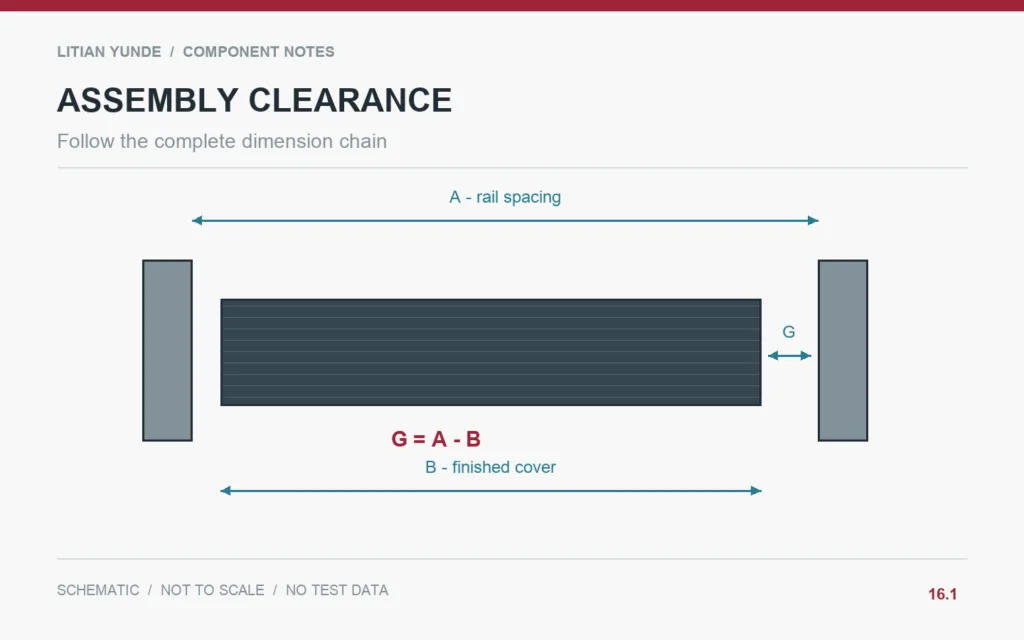
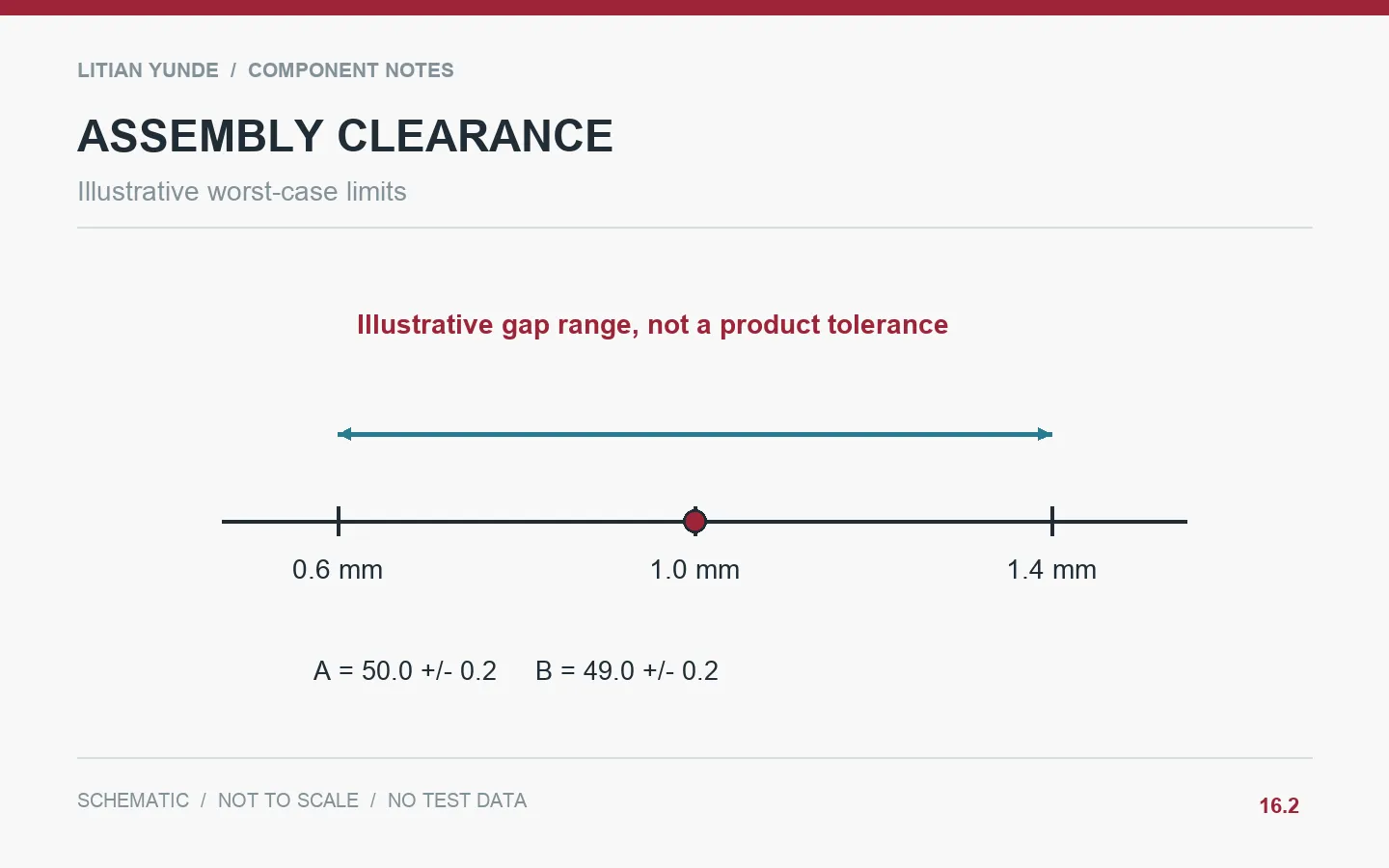
For a one-dimensional illustrative gap G = A – B, if A is 50.0 ± 0.2 mm and B is 49.0 ± 0.2 mm, independent worst-case limits give G from 0.6 to 1.4 mm. These invented values explain the arithmetic only; they are not recommended carbon fiber tolerances. Real assemblies may need additional dimensions, geometric controls and an appropriate analysis method.
Example: a cover sitting between two rails
The cover width and rail spacing are each within their drawings, but the finish allowance was omitted from the fit review. The teams revise the dimension chain to include the finished surfaces and check representative assemblies. The receiving report records the relevant component values and the resulting clearance, making future disagreements easier to investigate.
Scénario à titre d'exemple ; il ne s'agit ni d'un cas client ni d'un résultat de production avéré.
Éléments à convenir avant de passer commande
| Article à évaluer | Consigner pour accord |
|---|---|
| Functional output | Gap, engagement, flushness or alignment requirement. |
| Dimension chain | Contributing dimensions, signs and references. |
| Finished condition | Coatings, adhesive, washers and adjustment. |
| Validation | Analysis assumptions and representative assembly check. |
Questions posées par les acheteurs
Does a worst-case calculation predict every production result?
It gives bounds under stated assumptions, not a measured distribution or a guarantee about omitted variables.
Should every tolerance be made tighter?
No. Identify the dimensions driving the functional result before changing the specification.
Contexte technique et lectures complémentaires
Document d'information : NPL: Dimensional Metrology. La liste de contrôle du projet et l'exemple ci-dessus constituent des recommandations rédactionnelles ; ce document ne certifie pas un composant Litian Yunde.
- Liste de contrôle pour les dessins CNC de composants sur mesure en fibre de carbone
- Carbon Fiber Access Panels: Check the Removal Path, Not Only the Closed Fit
- Parcourez le centre de connaissances sur la fibre de carbone
Passez en revue votre composant avec Litian Yunde
Veuillez nous communiquer la version révisée du plan, l'application prévue ainsi que la question relative à l'interface ou au contrôle que vous souhaitez voir résolue. Les exigences de construction et de réception mentionnées sont validées pour ce projet spécifique.