
应用工程 · 元器件评审指南 · 立天云德
Follow the complete dimension chain. Original explanatory schematic; not to scale and not a product test result.
A carbon fiber component can meet its own drawing and still leave too much or too little clearance in an assembly. A tolerance stack relates the contributing dimensions to a functional gap. Include mating hardware, coatings and locating conditions, then confirm the approach with the responsible engineer.
Name the functional result first
Identify the clearance, flushness, alignment or engagement that the assembly needs. Sketch a dimension chain from the locating reference to that result. Do not start by tightening every component tolerance: some dimensions may have little effect while one overlooked interface controls the fit. The chain should include the parts actually supplied and the condition in which they are assembled.
Account for the supplied condition
Coatings, adhesive layers, washers and local pads can contribute to the assembled relationship. Specify whether dimensions describe unfinished or finished surfaces. State which features locate the component and which remain adjustable. If the installer pulls a flexible cover against a frame, document that condition rather than treating all geometry as independent rigid parts.
Use a simple example without turning it into a design rule
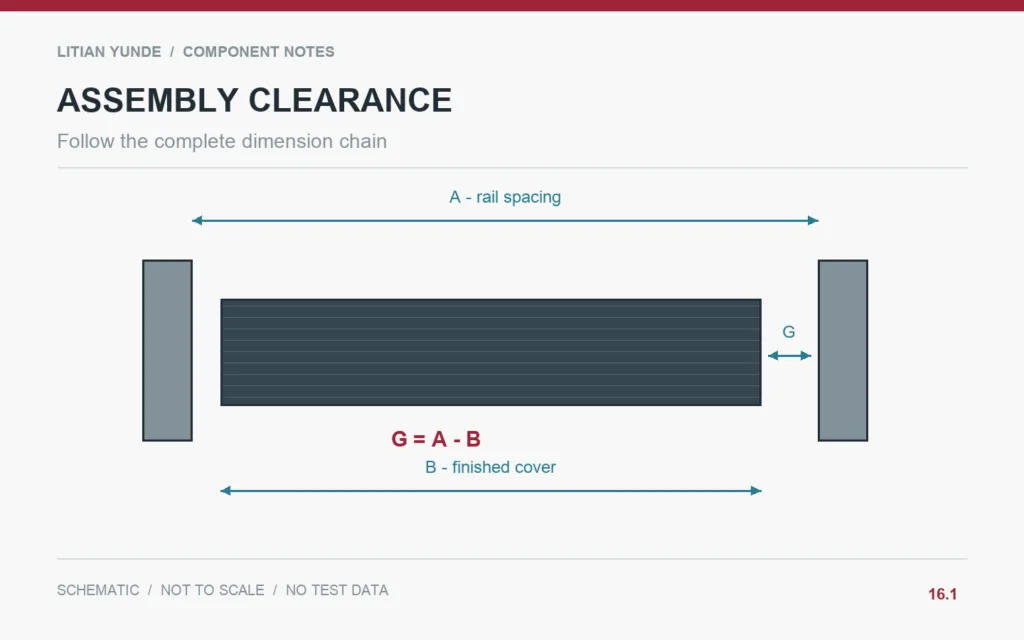
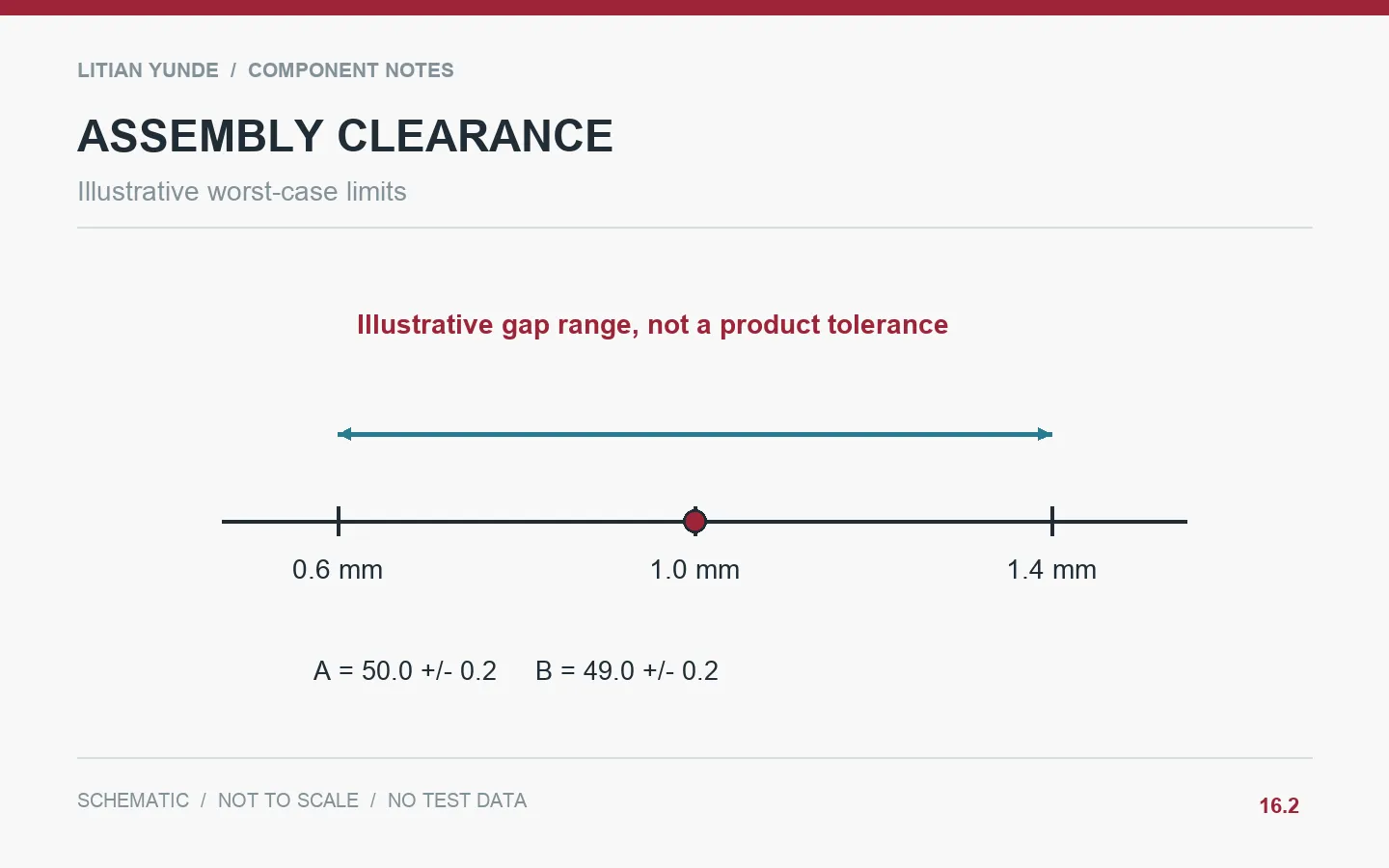
For a one-dimensional illustrative gap G = A – B, if A is 50.0 ± 0.2 mm and B is 49.0 ± 0.2 mm, independent worst-case limits give G from 0.6 to 1.4 mm. These invented values explain the arithmetic only; they are not recommended carbon fiber tolerances. Real assemblies may need additional dimensions, geometric controls and an appropriate analysis method.
Example: a cover sitting between two rails
The cover width and rail spacing are each within their drawings, but the finish allowance was omitted from the fit review. The teams revise the dimension chain to include the finished surfaces and check representative assemblies. The receiving report records the relevant component values and the resulting clearance, making future disagreements easier to investigate.
此为示例场景,并非客户案例或已报告的生产结果。.
下单前需确认的细节
| 评论对象 | 记录以示同意 |
|---|---|
| Functional output | Gap, engagement, flushness or alignment requirement. |
| Dimension chain | Contributing dimensions, signs and references. |
| Finished condition | Coatings, adhesive, washers and adjustment. |
| 验证 | Analysis assumptions and representative assembly check. |
买家常问的问题
Does a worst-case calculation predict every production result?
It gives bounds under stated assumptions, not a measured distribution or a guarantee about omitted variables.
Should every tolerance be made tighter?
No. Identify the dimensions driving the functional result before changing the specification.
技术背景及相关阅读资料
背景资料: NPL:尺寸计量. 上述项目检查清单和示例仅供编辑参考;本参考资料并不对利天云德的组件进行认证。.