
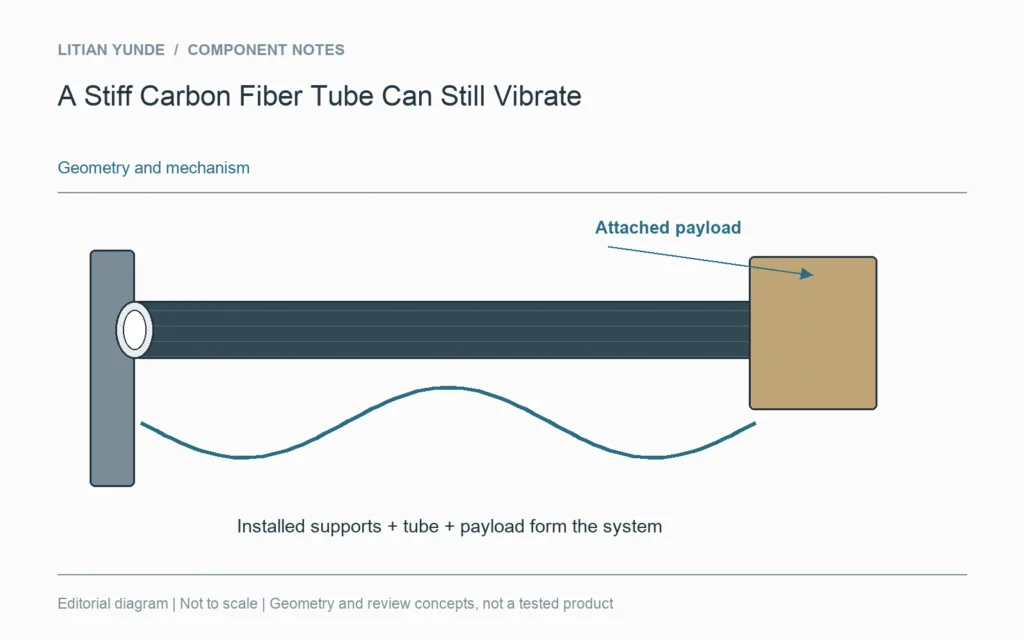
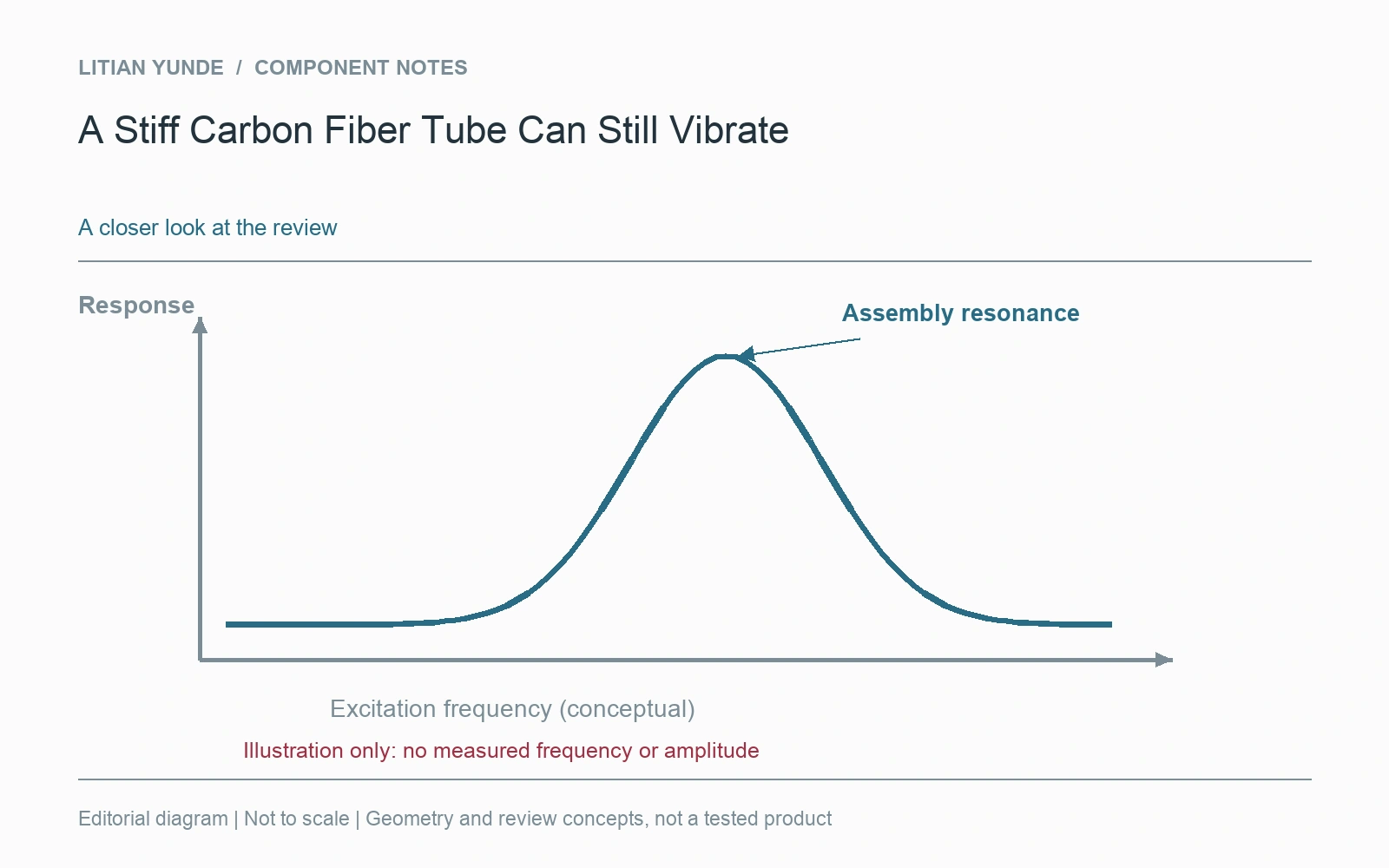
Static stiffness and vibration behaviour are related, but they are not the same requirement. A tube can show little movement under a slow load and still respond strongly to a motor, impact or repeating motion near an assembly resonance.
The attached parts belong in the model
Include the mounted sensor, camera, bracket or other payload when reviewing the tube. Their mass and location change the dynamic system. A tube clamped at one end is also a different system from a tube supported at both ends. The fixtures used in a supplier demonstration may not reproduce the boundary conditions of your equipment.
Ask what is exciting the member
List the operating speeds and repeating events that may introduce vibration. Motor speed, blade passage and intermittent movement can produce different excitation frequencies. If a problem occurs only in a particular operating range, retain that range instead of reducing the requirement to “no vibration”. Where measured data exist, include the measurement direction and sensor location.
Changing stiffness is one possible intervention
A shorter span, different section or revised laminate may shift the behaviour. Moving a payload, changing the support or introducing an engineered isolation arrangement can also change the system. More material is not an automatic cure. Compare interventions with the available space, alignment needs and operating conditions before requesting a thicker tube.
What a useful prototype check records
Record the complete fitted configuration, operating condition and observation point. Distinguish a static deflection check from a frequency or vibration measurement, and retain the method used for each. If the equipment changes, review whether the earlier result still represents it. This keeps an encouraging workshop observation from becoming a claim about every version of the assembly.