

Choose a tube shape around the frame interfaces and the way the member is loaded. Square tubes offer identifiable faces; round tubes suit circular collars and rotated positioning. Neither shape is a blanket promise of better stiffness or lower weight.
What changes at the connection
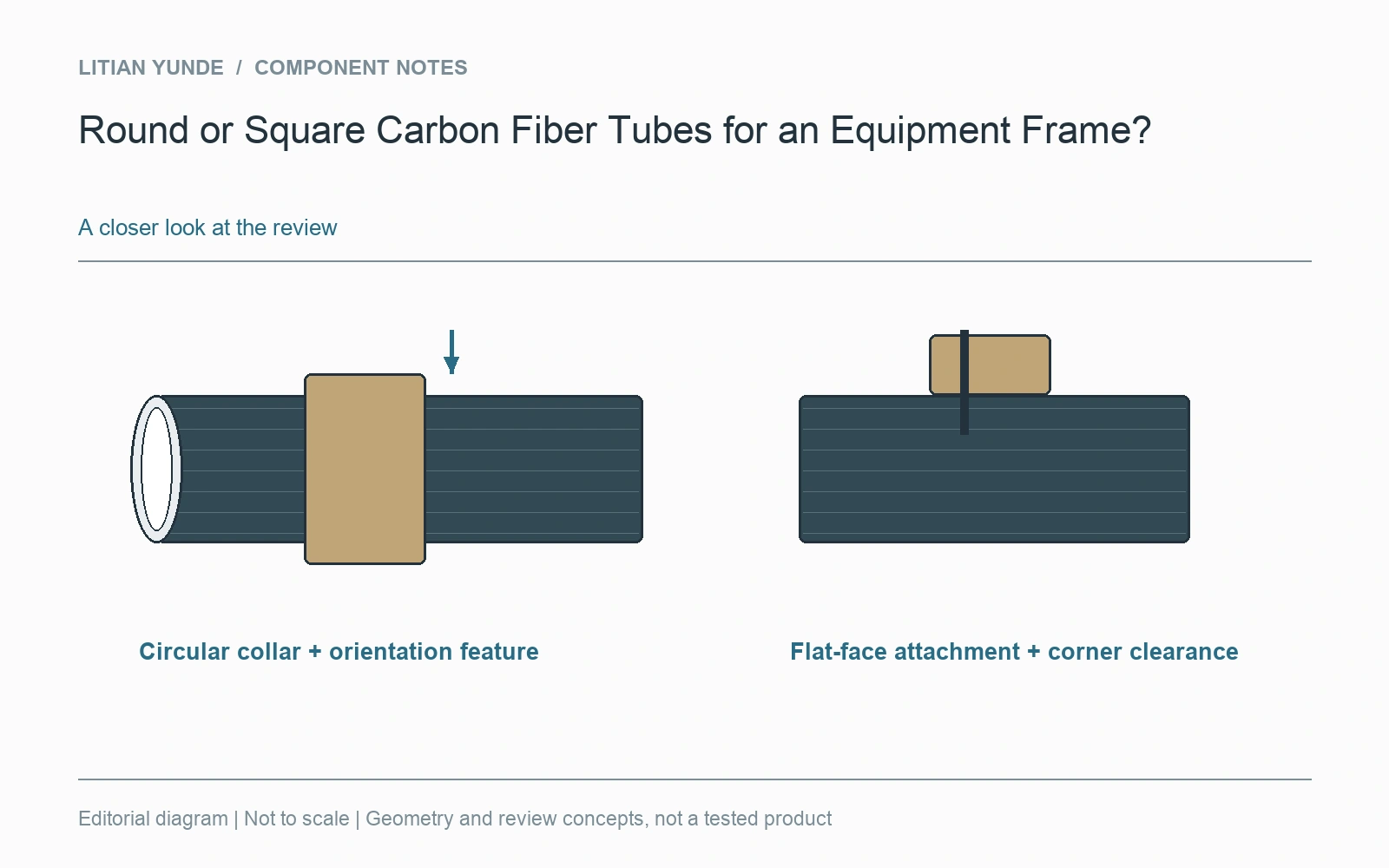
A square section gives brackets a flat reference face, which can simplify positioning accessories. Its corners and actual outside radii still need clearance in a matching socket. A round section can be paired with circular collars, but the assembly needs another feature if angular orientation must be retained. The cost and mass of those connecting parts belong in the comparison.
Compare sections on a fair basis
Equal outside dimensions do not make round and square tubes equivalent. Their material areas and second moments of area differ, and a composite laminate has its own directional properties. Establish whether the comparison holds mass, envelope or a stiffness requirement constant. For a real frame, evaluate bending directions, torsion and the connections rather than using a generic material label as the answer.
Faces are useful only when they are usable
Check how flat a mounting region needs to be and whether the proposed construction can provide it. Coating thickness, local surface variation and corner geometry affect how hardware seats. For a round tube, a collar should be reviewed with its contact shape and loading arrangement. In both cases, keep local contact demands separate from the behaviour of the length of tube.
Build the enquiry around one frame bay
An assembly sketch of one representative bay is a practical starting point. Show the joint, accessory contact and directions of load, then compare the two tube options with their proposed fittings. Ask for the actual construction, dimensions and interface tolerances of the quoted item. A shape decision made this way is easier to carry into a prototype than one based only on a product photograph.