
Machining & Assembly · Component review guide · Litian Yunde
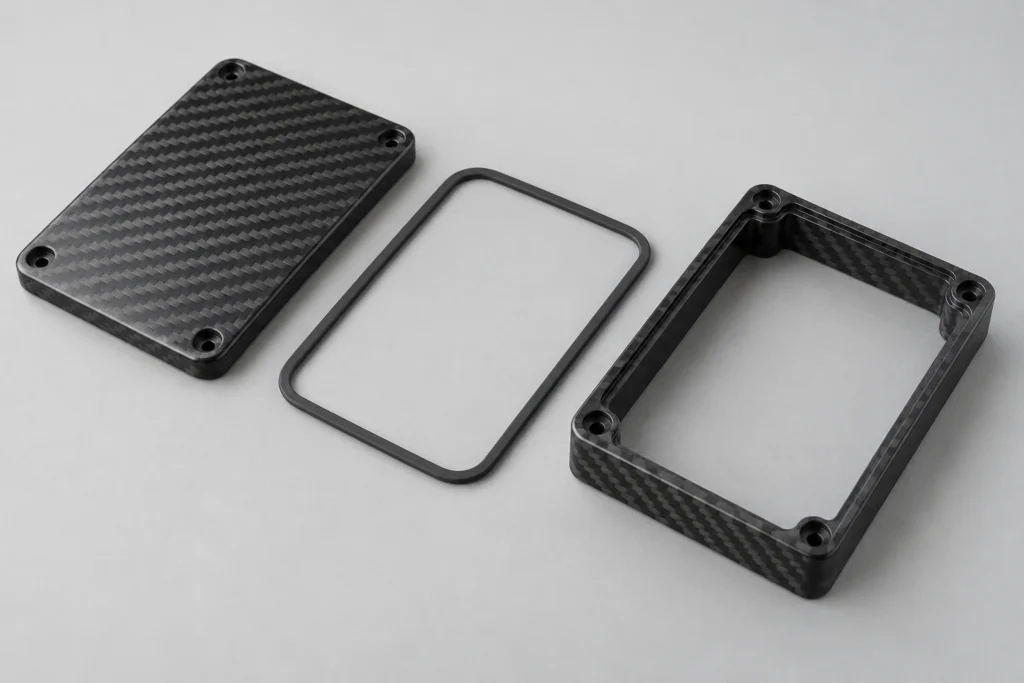
AI-generated explanatory concept; not a Litian Yunde product photograph or a validated design.
A seal fitted to a carbon fiber cover needs a defined installed condition. Specify the seal section, seating geometry, closure features and the requirements set by the seal or equipment designer. A visible gasket or a cover that closes does not establish the intended compression, sealing performance or serviceability.
Review the complete closure section
Show the cover, mating frame, seal and any adhesive or retaining feature. Identify where the seal sits before closure and which surfaces contact it after closure. Include corner transitions, joints and interruptions around hardware. Use the selected seal’s controlled information rather than drawing a generic rubber line. If the carbon part carries the seat, identify the relevant finished surfaces and local geometric requirements.
Define what limits closure
A stop, spacer or fastener arrangement may set the gap and therefore the installed seal condition. Review the stack of actual components, including finish layers where relevant. The responsible designer should establish the required compression and any installation method. Do not use extra tightening as a general solution to a gap. A geometric review should also check whether the seal is displaced or caught when the cover is installed.
Plan inspection and replacement
Agree how the installed condition will be checked without assuming that a closed cover is enough. If an ingress test is required, identify the complete configuration and assessment conditions. Separately document the seal reference, removal method and compatible replacement. A changed seal material or section can alter the interface even if its colour is the same. Keep service changes within the approved design and procedure.

Example: a lid stopped by spacers
A sample lid closes against spacers, but the proposed seal section does not match the intended closed gap. The team reviews the section and the controlled seal information before production. The final approval separates the gap and seating checks from the completed enclosure’s required sealing test.
Illustrative scenario, not a customer case or reported production result.
Details to agree before ordering
| Review item | Record to agree |
|---|---|
| Section | Seal reference, seat, frame and cover. |
| Closure | Stops, spacers and finished gap. |
| Check | Installed condition and separate sealing evidence. |
| Service | Replacement identity and approved procedure. |
Questions buyers ask
Can a thicker seal compensate for an uncertain cover gap?
It requires a design review of the complete closure, not an informal substitution.
Does a gasket establish an ingress rating?
No. Any claimed rating needs appropriate evidence for the specific completed assembly.
Technical background and related reading
Background resource: Hexcel: Composite Engineering Resources. Background reading only; the project checklist is editorial guidance, and this reference does not establish supplier certification or part approval.
- Carbon Fiber Assembly Tolerance Stacks: Check the Gap Between Parts
- Carbon Fiber Shell Flanges: Check Access to the Back of the Fastener
- Browse the carbon fiber knowledge centre
Review your component with Litian Yunde
Share the drawing revision, intended application and the interface or inspection question you need to resolve. The quoted construction and acceptance requirements are confirmed for the specific project.