
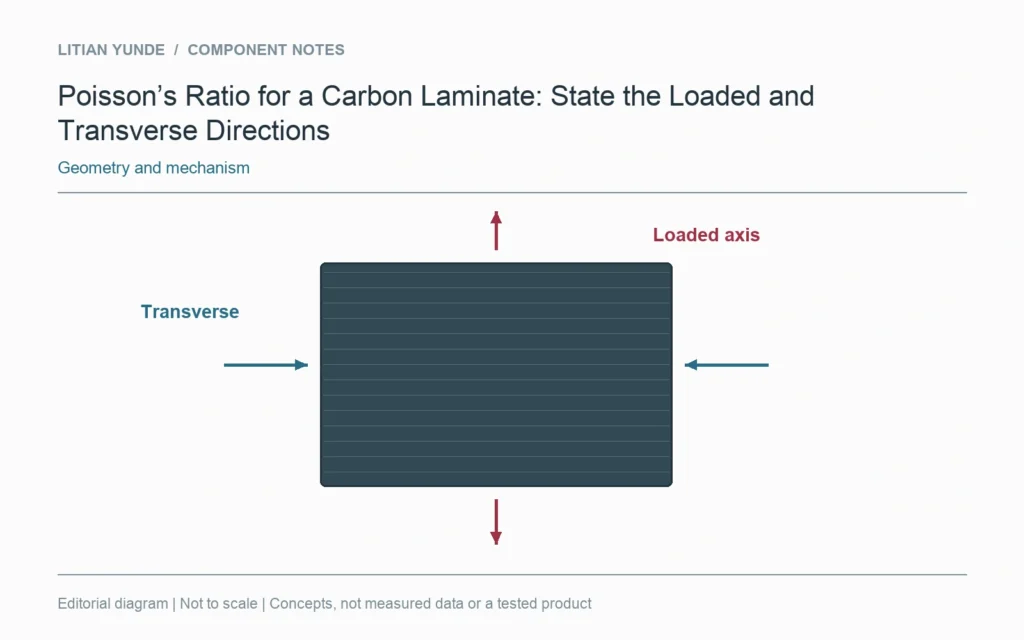
A laminate Poisson’s ratio needs directional labels. Identify the direction being loaded and the transverse strain being measured. Do not copy a single value from a fiber datasheet into every in-plane direction of a different laminate.
Make the strain pair visible
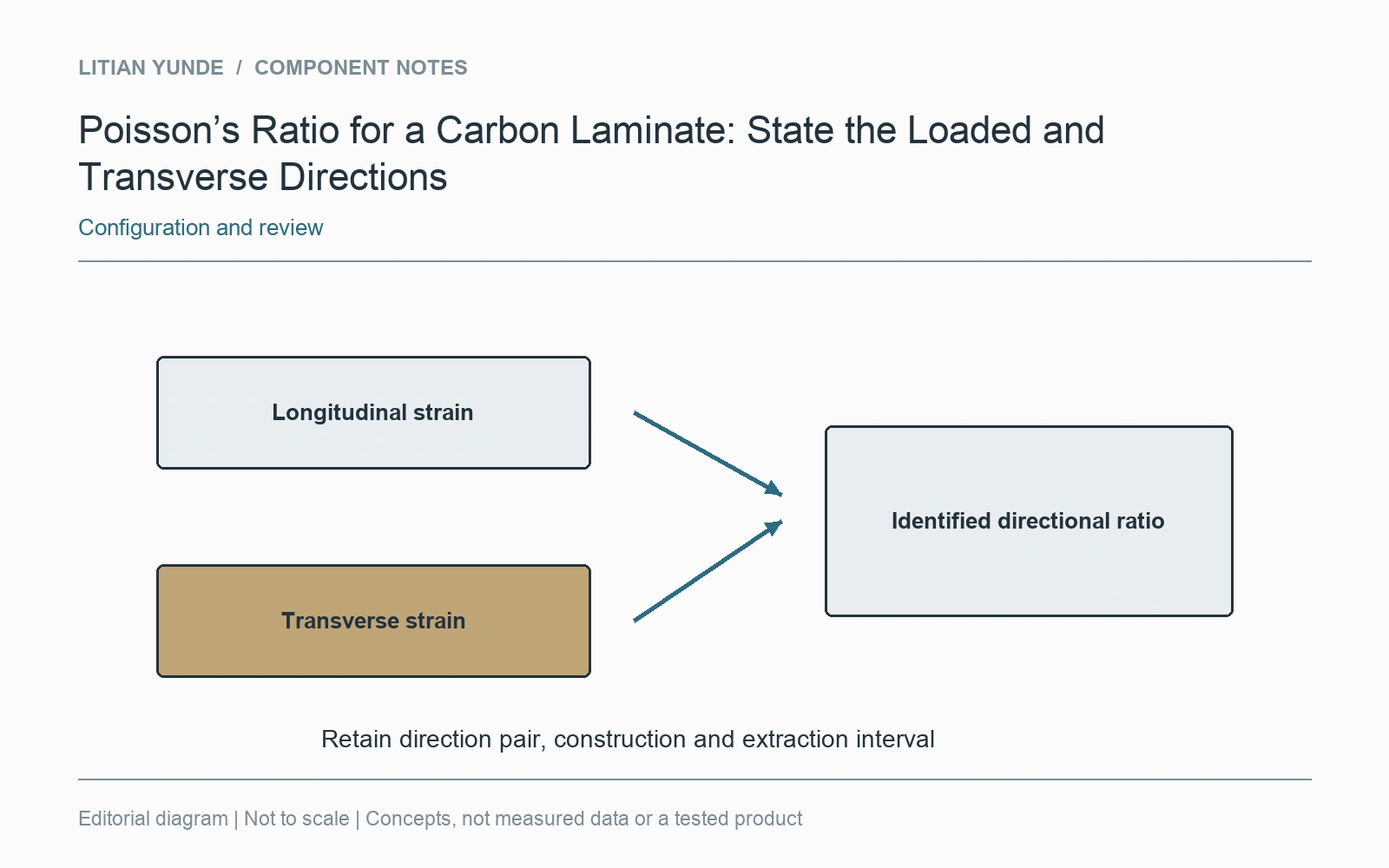
On the specimen drawing, show the loading axis and the transverse measurement axis. Retain the strain definition used for the reported ratio. A longitudinal strain trace alone does not supply the transverse response needed for that measurement.
Keep the test and construction attached
ASTM D3039 includes Poisson’s ratio among the properties obtainable within its tensile-test scope. Use the applicable method and edition for the actual material. The specimen layup and direction remain essential context; a shared carbon fiber name does not make different laminates equivalent.
Report the extraction basis
Ask the laboratory to retain the interval and procedure used to obtain the value, along with the measurement setup. If strain is extracted from optical data, identify the relevant region and axes. Keep a model input traceable to that test record rather than to an unexplained spreadsheet cell. A directional elastic value is useful when its construction and measurement basis remain readable.
Further reading: ASTM D3039: tensile-property method scope.