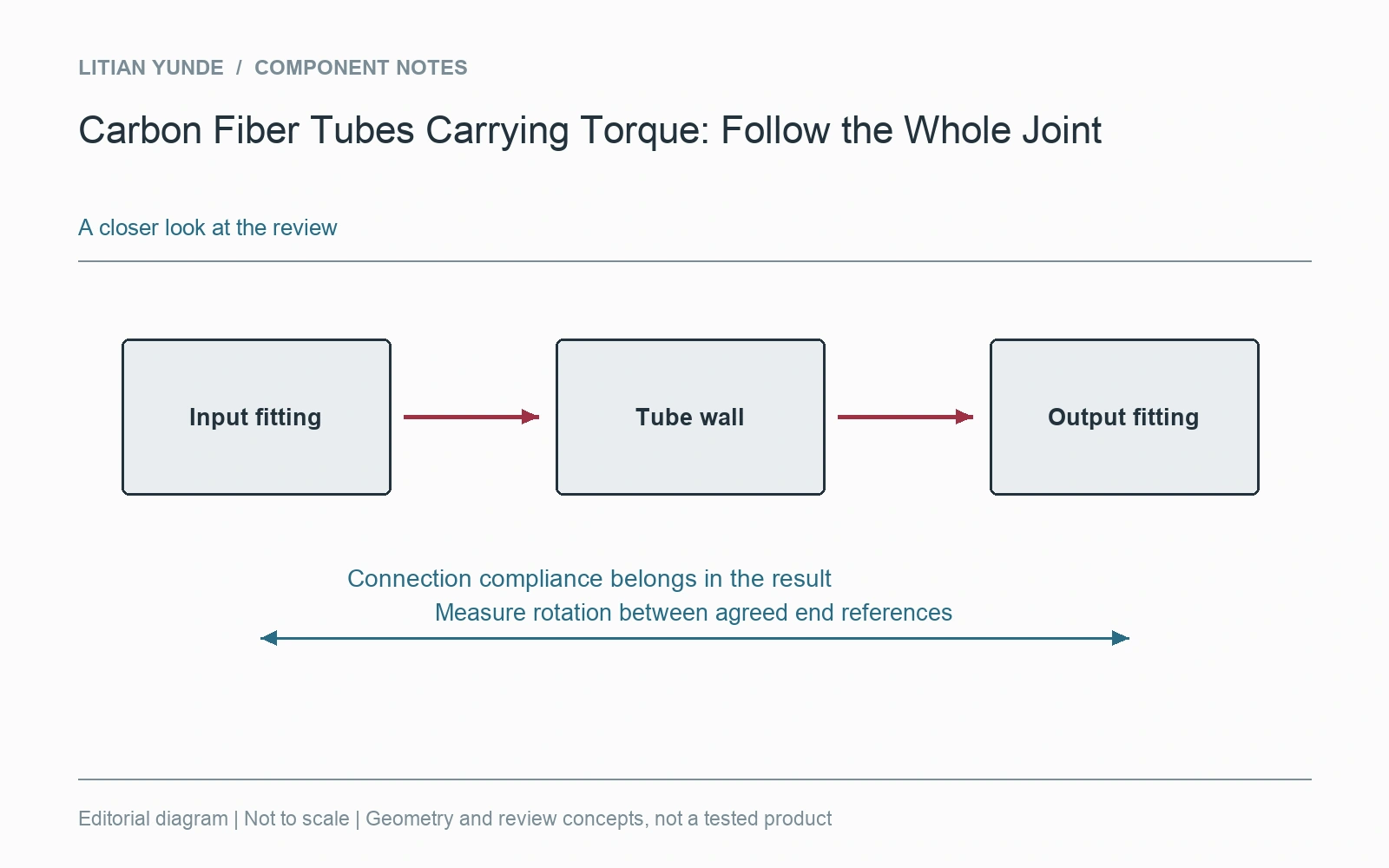
对于承受扭矩的碳纤维管,仅靠直径规格是不够的。管材的层压结构及其两端连接件共同构成了一条载荷传递路径。即使管材本身看似未发生变化,但若接头相对于管材发生转动,仍可能决定整个组件的行为表现。.
Identify where rotation is introduced and where it is resisted. Mark adapters, bonded regions, mechanical keys and any bearings or supports. If torque enters through a small attachment, review that local region as well as the long tube. An end connection that works for axial pulling is not automatically suitable for repeated twisting.
Axial stiffness does not answer the torsion question
Composite construction can be tailored in different directions. A tube described as stiff along its axis therefore still needs torsional data or an appropriate design review for the proposed use. Surface weave is not a reliable description of the complete wall. Ask about the quoted laminate and keep any comparison tied to that construction rather than the broad category “carbon fiber tube”.
Specify the movement as well as the load
Rotational displacement can matter before a component reaches a failure condition. A positioning system may require limited twist between its ends, while another assembly may tolerate more movement. State the torque, its direction and whether it is steady, reversed or repeated. Show where the rotation will be measured so the connection compliance is included consistently.
Use an assembly-level sample record
For a sample check, retain the tube revision, fittings, joining process and the test arrangement. Mark the measured reference features on each end. Keep a visual check for fitting movement separate from a measured torque–rotation result: both can be useful, but they establish different things. Changes to an adapter or bond region should trigger a review of the assembly result, even if the purchased tube size stays the same.