
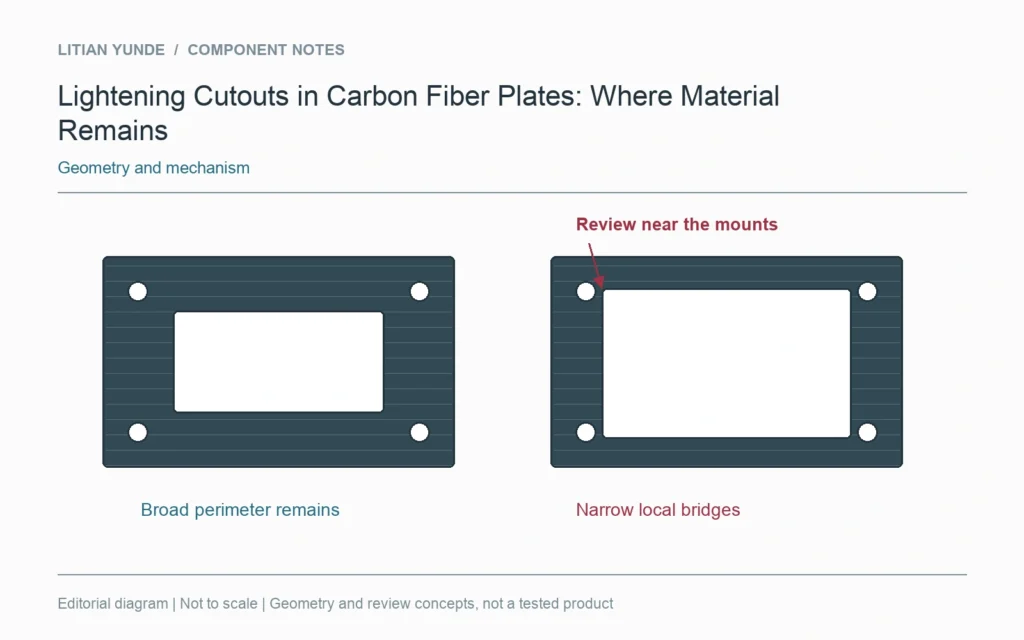
两种板材布局虽然能去除相同的面积,但在其安装点之间留下的路径却可能大不相同。在对碳纤维板进行轻量化处理时,关键问题在于剩余材料在何处承担载荷,而不仅仅是板材有多少部分被镂空。.
Mark the supports, payload contacts and fasteners before drawing decorative openings. Those locations show where loads enter and leave the plate. A broad opening placed between two attachments can leave a thin bridge even when most of the outside perimeter remains untouched. Look at each bridge in the installed direction rather than judging the outline as a flat graphic.
Corners and nearby holes deserve a closer look
Cutouts interrupt the laminate, and local stress around an opening depends on more than its total area. Corner shape, neighbouring features and material direction can affect the result. There is no universal web width or corner radius that makes every carbon plate suitable. Use the proposed construction and load case when reviewing the remaining strips, especially where an opening runs close to a fastener.
Weight savings that survive assembly
Removing material may leave less room for a washer, cable clip or local support. Check those contacts on the same layout. If the new shape needs extra brackets or larger fittings, include those parts when comparing mass. A plain plate with a smaller outline may sometimes be a more useful option than a large plate with many complicated openings; the choice depends on the assembly.

Review the layout in two stages
First check geometry: tool access, internal corners, clearances and the contact areas required by the hardware. Then check performance through the appropriate calculation or sample validation. A machining review confirms that a proposed shape can be discussed for manufacture; it does not by itself establish strength. Keep the accepted cutout pattern on a controlled drawing so later cosmetic changes do not quietly alter the component.
Technical background: NASA: stress concentration around a hole in a composite plate.