

When the back of a carbon fiber part cannot be reached, the fastening concept has to address installation and later removal from the accessible side. Choosing a familiar fastener name is only the start; the local laminate and attachment loads still need review.
A nut can be fitted before an enclosure is closed and become inaccessible afterward. That may be acceptable for a permanently closed assembly, but awkward for a cover intended to be removed. Map the sequence and ask whether the hardware can be held, replaced or recovered after the product is complete. A loose nut inside an enclosed part is a different problem from an accessible bolted joint.
Compare concepts rather than catalog labels
A bonded threaded insert, a captive nut plate and suitable blind hardware offer different ways of retaining a thread or attachment. They need different space, preparation and inspection. The locally applied forces also differ. Hardware designed around thin metal sheet should not be assumed to work in a composite laminate without assessing the installation mechanism and contact condition.
The area around the hole does work
Show available laminate thickness, edge distances and room for any flange or backing feature. Identify the loads at the connection, including tightening and service loads. If an attachment transfers force through a small local region, the joining concept may require more than a change in hole size. Avoid publishing a universal fastener torque based on carbon fibre as a material name.
Try the service operation on the sample
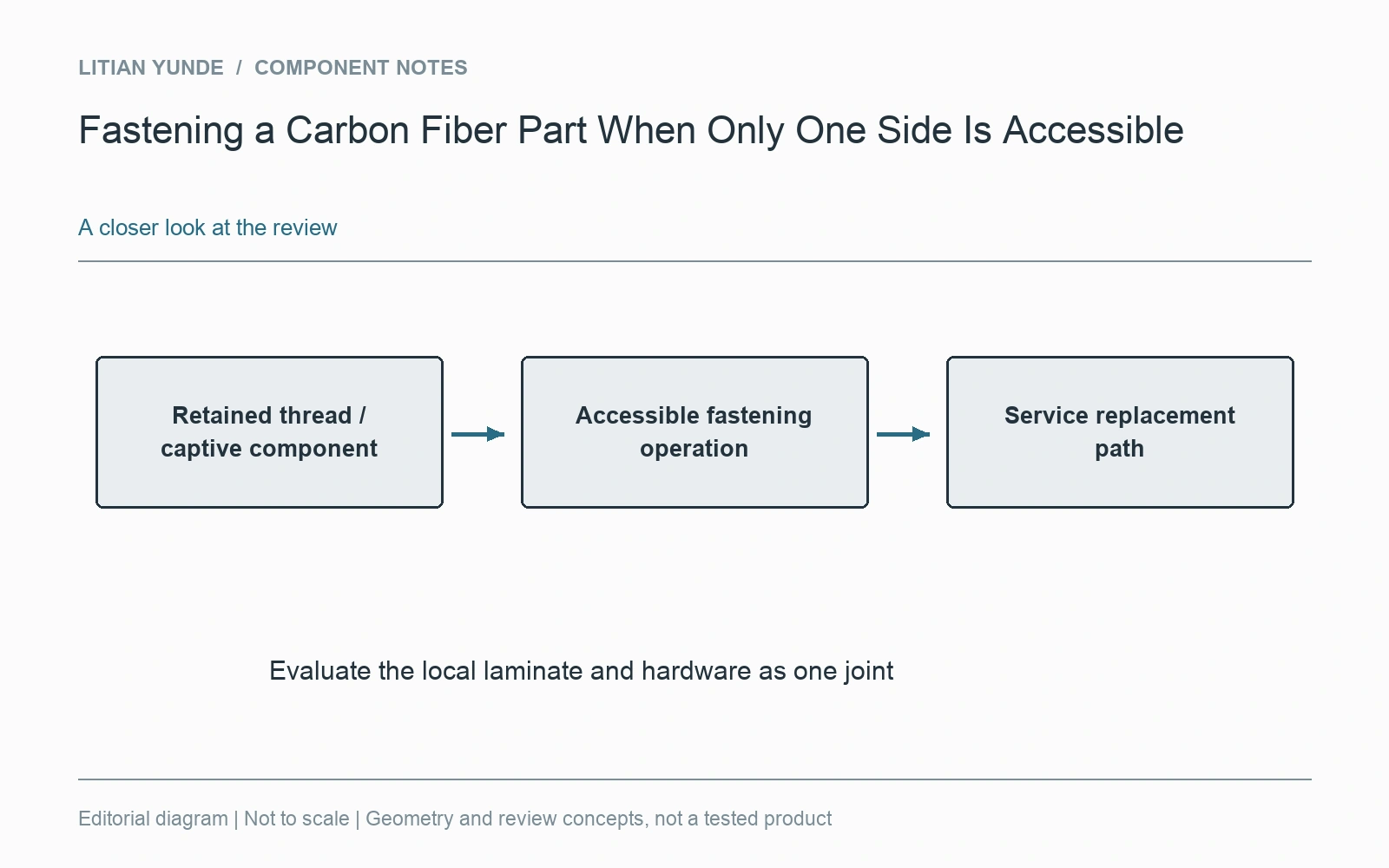
A useful sample review includes removing and reinstalling the actual hardware through the intended access opening. Check whether the retained component stays in place, whether a tool can reach it and how a damaged thread would be handled. Keep those observations with the accepted joint configuration. They explain the practical value of one-sided access more clearly than a photograph of an isolated insert.