
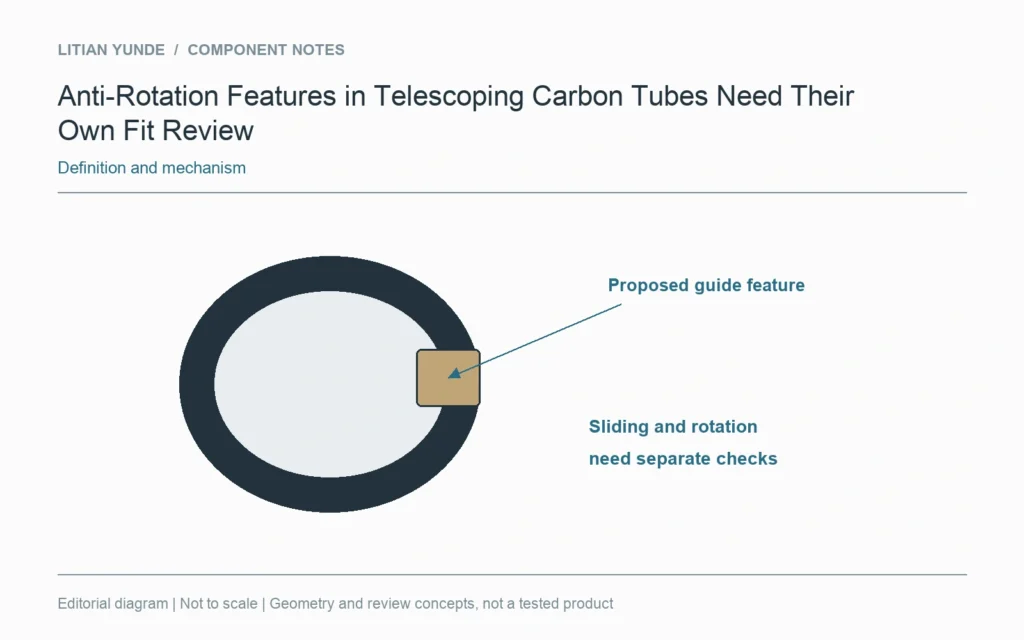
A telescoping assembly can need both sliding clearance and resistance to relative rotation. Those are different requirements. If a key, guide or other anti-rotation feature is proposed, define its relationship to the tube travel and connection loads.
Show which component guides translation and which component controls rotation. These functions may share an interface, but that should be an explicit design decision. A non-round profile or added guide is not a complete statement of the acceptable play, friction or load transfer.
Review the full operating range
Locate the guide engagement and any changes through the stroke. Include end fittings, stops and installed orientation where they affect the arrangement. A short fit check at one position may not describe the complete assembly movement or the response under its intended duty.
Agree separate checks
Specify the relevant sliding and rotational behaviours to be evaluated in the identified setup. Retain the actual mating components and their revisions with the sample record. If one interface is changed to improve sliding, review its effect on the other requirement rather than assuming the correction is independent. No universal guide clearance, allowable rotation or operating load is defined by the phrase “anti-rotation tube.”
