
Plates & Panels · Component review guide · Litian Yunde
An outline also needs a reference. Original explanatory schematic; not to scale and not a product test result.
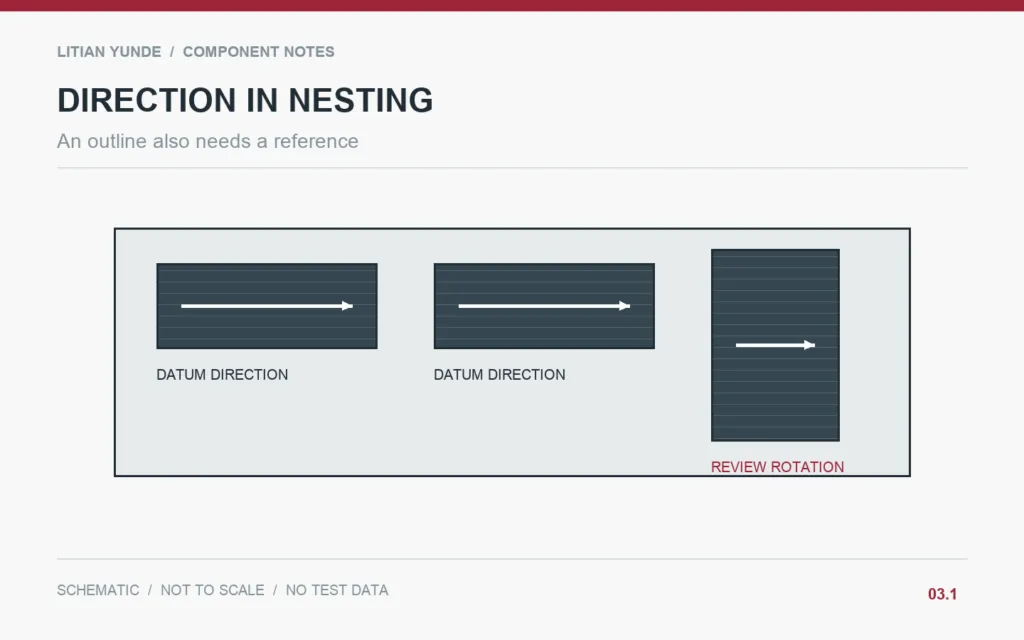
Before rotating a carbon fiber part to improve sheet utilisation, check whether material direction is controlled. A nesting layout should preserve the specified orientation and visible weave direction. Permission to rotate for appearance is different from permission to change the laminate orientation.
Use a datum arrow that survives the file handoff
Put a direction arrow on the part drawing and identify what it refers to: a laminate reference direction, a fabric direction or a cosmetic weave direction. Do not rely on the horizontal axis of an exported file. CAD files can be rotated during conversion, while a clear labelled reference remains interpretable after nesting and inspection.
Separate appearance from engineering orientation
A visible woven face does not reveal the complete stacking sequence. If only appearance is controlled, say so. If the engineering design controls the laminate, provide the material specification and reference direction. Hexcel’s prepreg guide discusses fibre orientation as a contributor to laminate behaviour; a purchasing drawing still needs the particular orientation rule for the actual part.
Approve nesting changes before cutting
Show which rotations and mirrored layouts are allowed. A mirrored outline may keep dimensions correct while changing face identification or the position of an asymmetric detail. Request an annotated nesting proposal when direction or face matching matters. The decision should come before cutting, not after a finished batch displays alternating patterns.
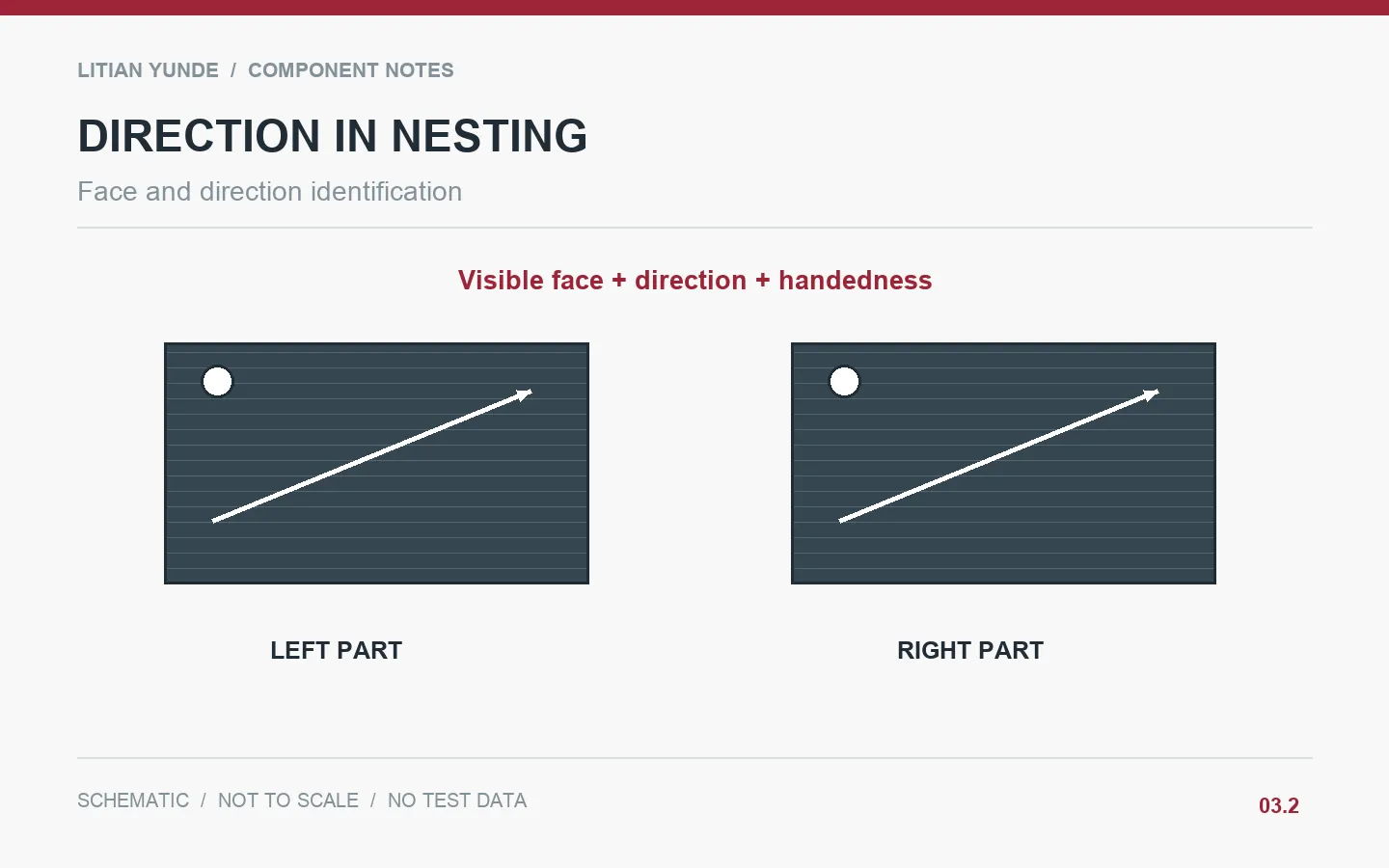
Example: paired dashboard inserts
Two matching trim pieces fit their openings, but their diagonal surface patterns run in different directions because one outline was rotated in the sheet layout. The next order identifies the visible face and a weave reference arrow for each handed part. The approved nesting drawing shows the pair together. This resolves the appearance requirement without claiming a particular structural laminate.
Illustrative scenario, not a customer case or reported production result.
Details to agree before ordering
| Review item | Record to agree |
|---|---|
| Direction reference | Material specification and arrow on the part drawing. |
| Allowed rotation | List permitted rotations rather than assuming any angle. |
| Handedness | Separate left/right and front/back references. |
| Approval record | Nesting revision and the person authorising exceptions. |
Questions buyers ask
Does a twill pattern show all the fibre directions?
No. It shows the surface pattern, not the complete internal laminate.
Can parts always be rotated by 180 degrees?
Do not assume it. Check the drawing, face requirements and laminate specification first.
Technical background and related reading
Background resource: Hexcel: Prepreg Technology. The project checklist and example above are editorial guidance; this reference does not certify a Litian Yunde component.
- Carbon Fiber, Fabric and Laminate: Three Different Things
- Carbon Fiber Plate Flatness: Free-State and Mounted Measurements
- Browse the carbon fiber knowledge centre
Review your component with Litian Yunde
Share the drawing revision, intended application and the interface or inspection question you need to resolve. The quoted construction and acceptance requirements are confirmed for the specific project.