

Plaques et panneaux · Guide d'évaluation des composants · Litian Yunde
Concept explicatif généré par l'IA ; il ne s'agit ni d'une photographie de produit de Litian Yunde ni d'un design validé.
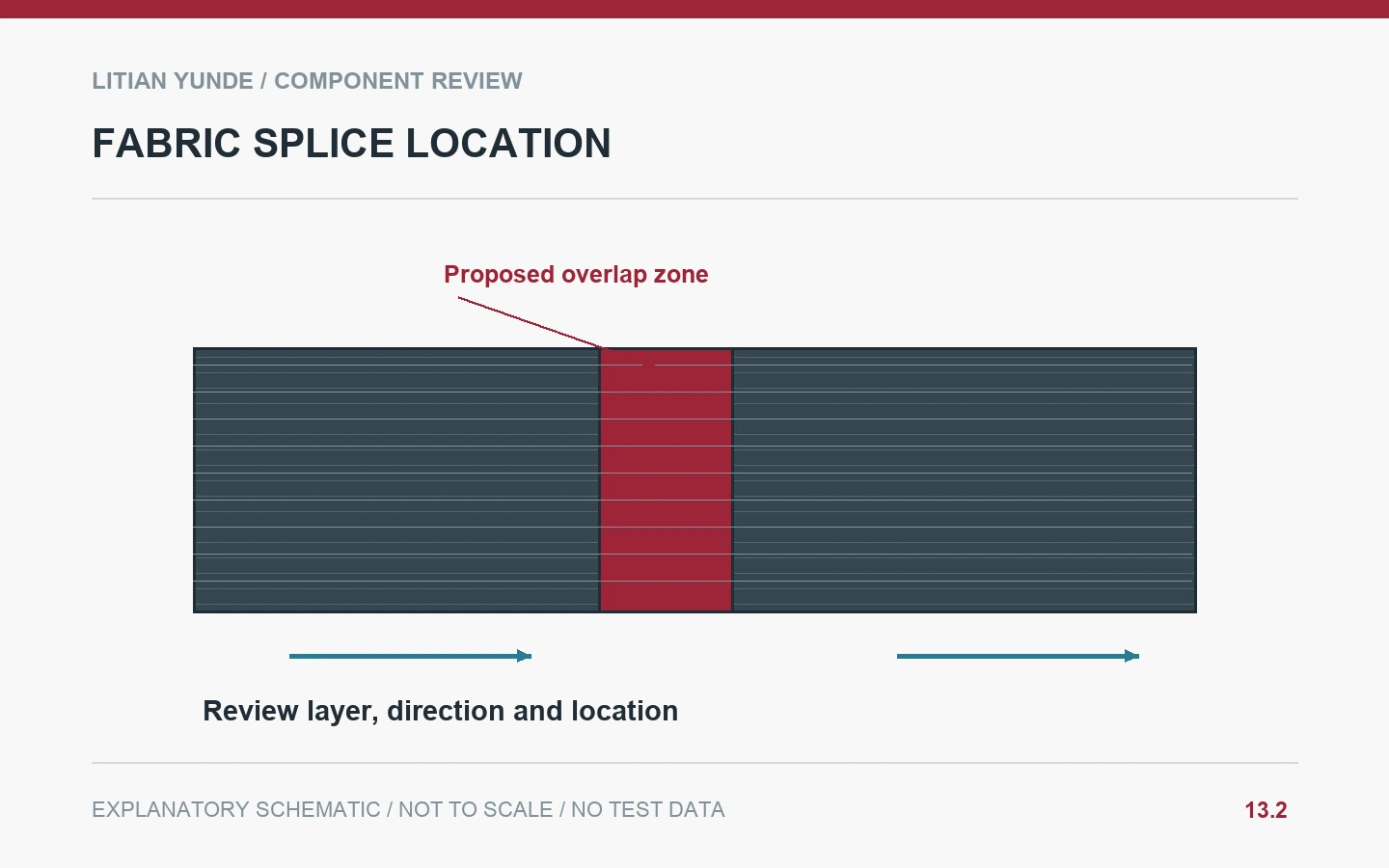
A carbon fiber fabric splice needs a defined role and location in the proposed laminate. Discuss where pieces meet or overlap before moulding, including any visible-face requirement. A visually continuous weave pattern does not prove reinforcement continuity, and an attractive seam cannot replace approval of the construction.
Separate appearance from the laminate design
Ask whether a splice concerns only the visible outer fabric, an underlying reinforcement layer or both. These are different questions. Use the controlled construction information to describe the relevant layer and direction. The responsible designer should decide where discontinuities or overlaps are permitted. This article gives a procurement review structure, not a universal splice length, ply arrangement or structural acceptance rule.
Mark permitted and restricted regions
Identify the proposed splice zones relative to holes, edges, curved regions and attachments. If appearance is important, agree the visible boundaries and viewing condition separately. Do not require a seamless cosmetic appearance that contradicts an approved construction without discussing the conflict. Keep the material direction and part identity on the location map. A photograph may show a surface seam but cannot reliably reveal every internal ply boundary.
Control changes between sample and repeat production
Record the approved construction and any permitted placement variation. If a fabric size or cutting plan changes, review its impact before treating the replacement as equivalent. Keep the sample approval specific: surface appearance, construction review and performance validation should not collapse into one vague sign-off. The supplier should state which construction records or evidence it can provide for the ordered scope.
Example: a large visible cover
A buyer requests a large woven cover with an uninterrupted appearance. The supplier proposes a fabric join because of the available cut size. The project reviews the join location and separately confirms the construction with the responsible designer. The approved surface reference shows what is visible; it is not presented as proof of an unseen laminate arrangement.
Scénario à titre d'exemple ; il ne s'agit ni d'un cas client ni d'un résultat de production avéré.
Éléments à convenir avant de passer commande
| Article à évaluer | Consigner pour accord |
|---|---|
| Layer | Visible fabric, reinforcement or both. |
| Lieu | Mapped permitted and restricted splice zones. |
| Approbation | Construction review and appearance reference. |
| Modifications | Material/cutting changes and repeat-order records. |
Questions posées par les acheteurs
Does matching the weave conceal the structural question?
It may improve appearance, but continuity and construction still require their own review.
Can a supplier move a splice without changing the outline?
The outline alone does not define the laminate. Follow the agreed construction-change process.
Contexte technique et lectures complémentaires
Document d'information : Hexcel : Ressources en ingénierie des composites. À titre d'information uniquement ; la liste de contrôle du projet constitue une orientation rédactionnelle, et ce document ne vaut ni certification du fournisseur ni homologation des pièces.
- Fibre de carbone, tissu et stratifié : trois choses différentes
- Repères sur les plaques en fibre de carbone : convenir d'un repère commun avant de comparer les positions des trous
- Parcourez le centre de connaissances sur la fibre de carbone
Passez en revue votre composant avec Litian Yunde
Veuillez nous communiquer la version révisée du plan, l'application prévue ainsi que la question relative à l'interface ou au contrôle que vous souhaitez voir résolue. Les exigences de construction et de réception mentionnées sont validées pour ce projet spécifique.