

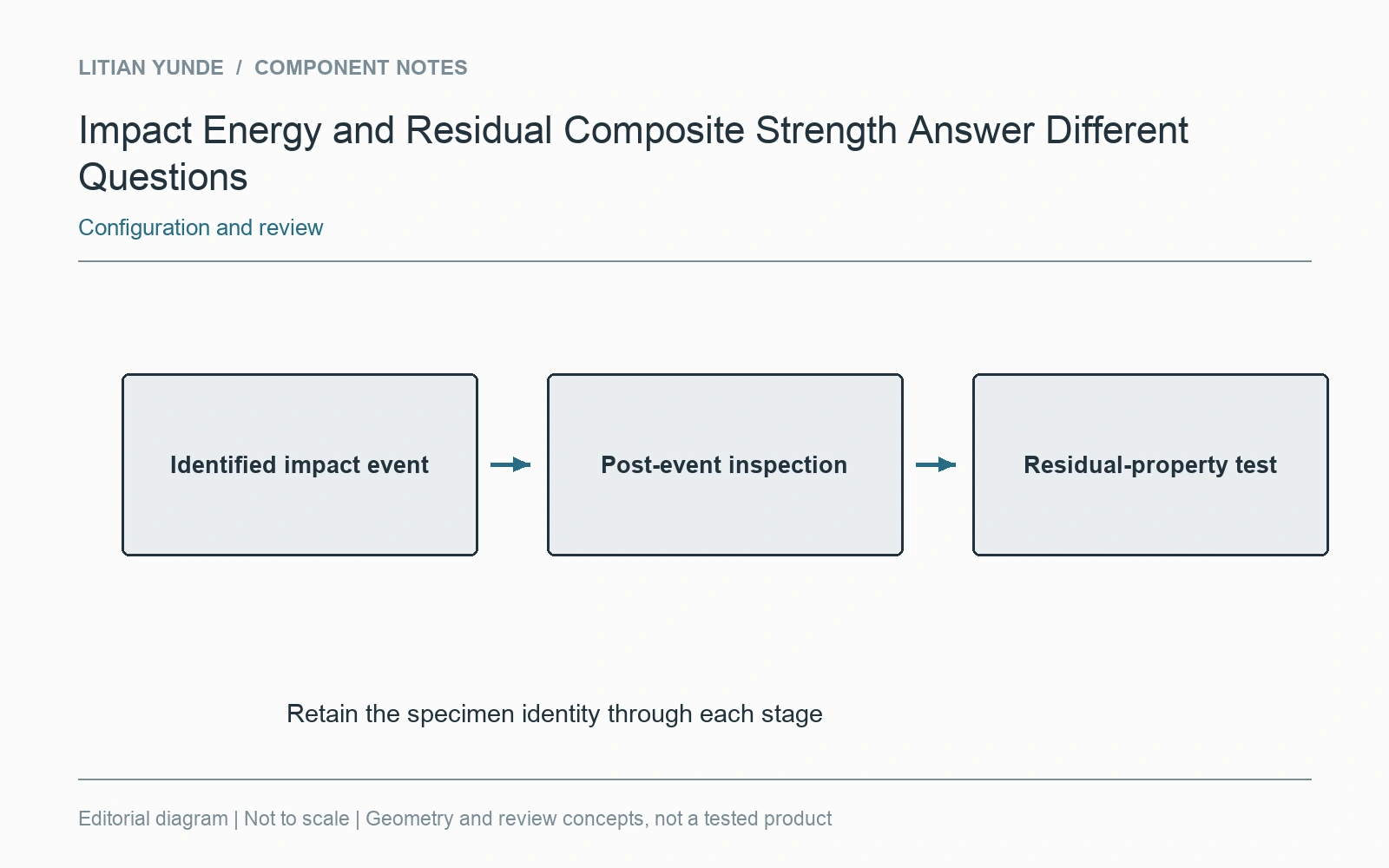
An impact event and a later strength test describe different stages of an evaluation. Recording the impact energy does not, by itself, state how much load the damaged laminate can carry. Keep the impact configuration and subsequent assessment connected.
Describe the impact setup
Identify the specimen, support arrangement, impactor and event conditions required by the agreed method. Energy alone omits important information about how the event was introduced. A dropped object in an informal demonstration is not automatically equivalent to a controlled impact test.
Record the state after the event
Visible appearance is one observation. A specified inspection or residual-property test asks another question. Do not use an unremarkable photograph as proof that no consequential damage exists, or infer a residual strength from a dent size without an applicable assessment.
Define the intended conclusion
If the project requires compression-after-impact or another residual test, include that scope in the enquiry and allocate the relevant specimens. Keep specimen identities and their event histories linked. ASTM provides distinct methods for impact damage and subsequent assessment; select the appropriate requirements with the responsible technical reviewer. This guide gives no continued-use approval for a damaged component.
Further reading: ASTM: impact and residual strength test methods.