

In a process using a rigid mould on one side and a vacuum bag on the other, the two faces experience different contact conditions. Calling both faces “carbon finish” can hide that distinction. Identify which face will be visible and how the other face will be used.
The moulded face and the process face
The rigid tool can influence the surface it contacts, while the opposite face may reflect the chosen bagging and auxiliary materials. The result depends on the actual process; a matched-tool route is a different arrangement. Ask what is proposed rather than applying the same appearance expectation to every manufacturing method.
Check the back face for its actual job
A hidden face may still locate a bracket, carry adhesive or contact a seal. Its function therefore needs a suitable definition even when it is not cosmetic. Conversely, a uniform-looking surface does not establish dimensional fit. Describe the relevant mating region and the condition in which it will be measured or used.
Approve the faces separately when necessary
Label the faces on the drawing and retain photographs or appearance references in the correct orientation. State whether secondary finishing is included and which areas it affects. If a later process changes one face, review its contact and dimensional requirements as well as appearance. This is more useful than treating the front photograph as a complete description of the part.
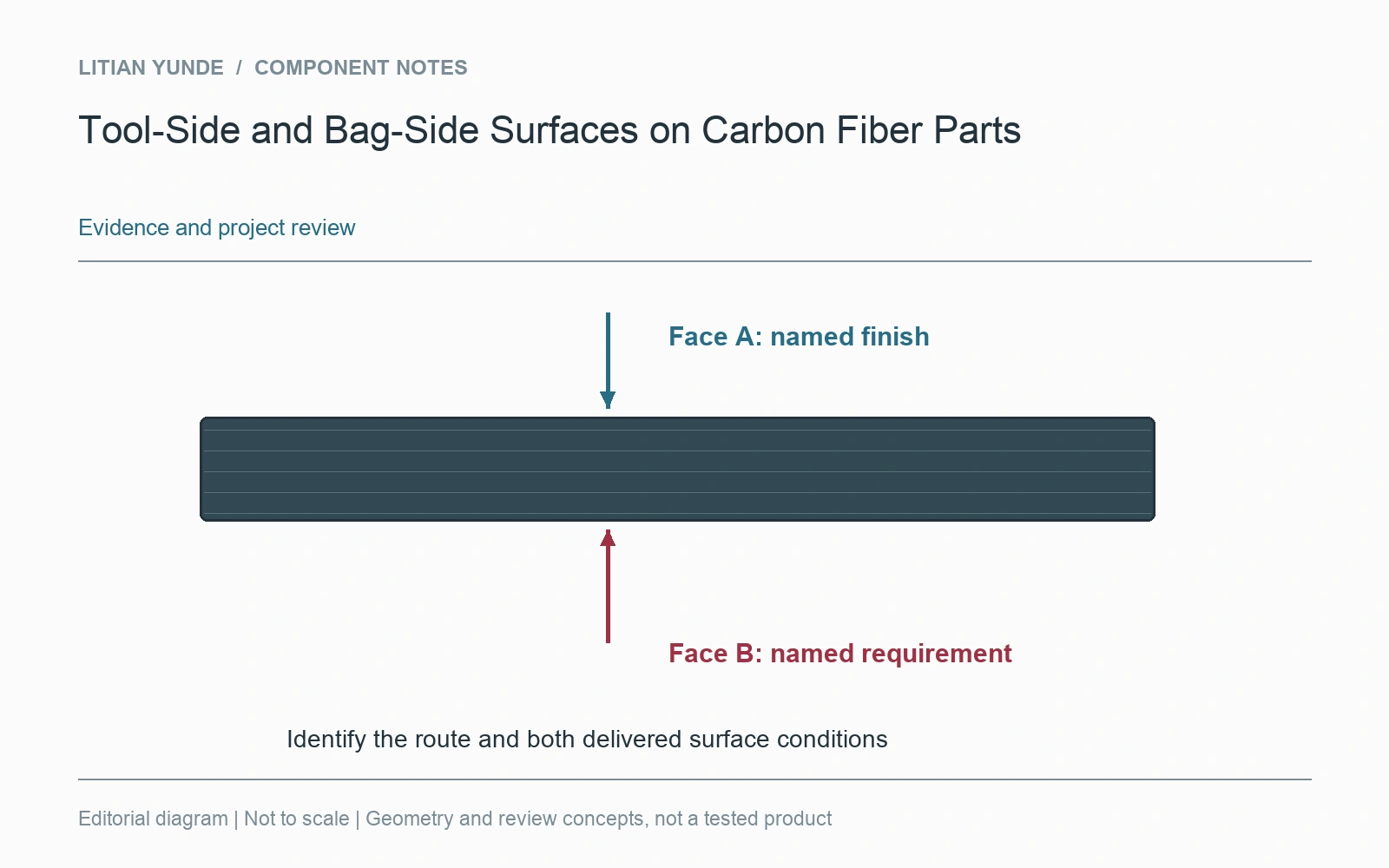
For the project review: proposed manufacturing route; tool and opposite-face identity; cosmetic versus mating requirements; included secondary finish.
Further reading: Gurit: guide to composites.