
Inspection & Testing · Component review guide · Litian Yunde
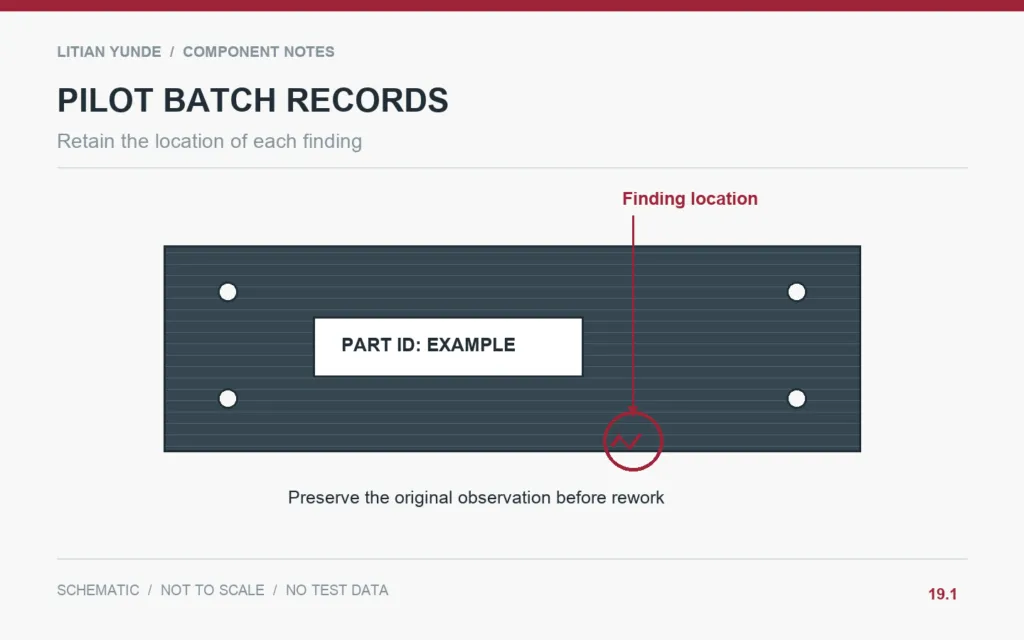
Retain the location of each finding. Original explanatory schematic; not to scale and not a product test result.
A pilot-batch report should connect each observed issue to a specific part, feature and disposition. Keep first-pass results separate from results after rework. Otherwise a batch can appear fully accepted while the information needed to improve repeat production disappears.
Agree the review categories before production
Distinguish dimensional, cosmetic, assembly and documentation findings. State the acceptance basis for each, including any approved sample references. Avoid using a single broad label such as “bad finish” when photographs and a location map could identify a repeatable issue. The goal is a record that supports a decision, not an inflated defect count or a hidden one.
Preserve the original result
Record the part identifier, observation, measurement method and drawing revision before any rework. Separate accepted parts, items awaiting review and rejected items physically or through a reliable status system. A reworked part should retain its identity and the reason for rework. This makes it possible to see whether the process produced the required result on the first pass.
Require an authorised disposition
Use a clear decision path for rework, repair, concession or rejection, as applicable to the contract. These decisions are not interchangeable. An inspector should not turn an unapproved repair into a normal production step by recording only the final appearance. Close the record with the authorised instruction, reinspection result and any change needed before the next batch.

Example: a small run of machined covers
Several covers have the same local edge issue. The team photographs the location and records affected identifiers before deciding on an approved rework. Reinspection results are added without deleting the first-pass findings. The next production review can then compare the original occurrence with the revised process, rather than merely reading that every shipped cover eventually passed.
Illustrative scenario, not a customer case or reported production result.
Details to agree before ordering
| Review item | Record to agree |
|---|---|
| Identification | Part/lot, drawing revision and inspection stage. |
| Finding | Location, category, evidence and acceptance reference. |
| Disposition | Authorised action and responsible approval. |
| Closure | Reinspection, release status and process follow-up. |
Questions buyers ask
Should successfully reworked parts count as first-pass acceptance?
No. Report their accepted final state while preserving the fact that rework was required.
Does a pilot batch establish long-term process capability?
Not by itself. Its size, sampling plan and production representativeness limit the conclusion.
Technical background and related reading
Background resource: NIST: Measurement Process Characterization. The project checklist and example above are editorial guidance; this reference does not certify a Litian Yunde component.
- From Carbon Fiber Prototype to Repeat Production: The Handoff Package
- Checking Fixtures for Carbon Fiber Parts: What a Go/No-Go Result Means
- Browse the carbon fiber knowledge centre
Review your component with Litian Yunde
Share the drawing revision, intended application and the interface or inspection question you need to resolve. The quoted construction and acceptance requirements are confirmed for the specific project.