
Tubes & Interfaces · Component review guide · Litian Yunde
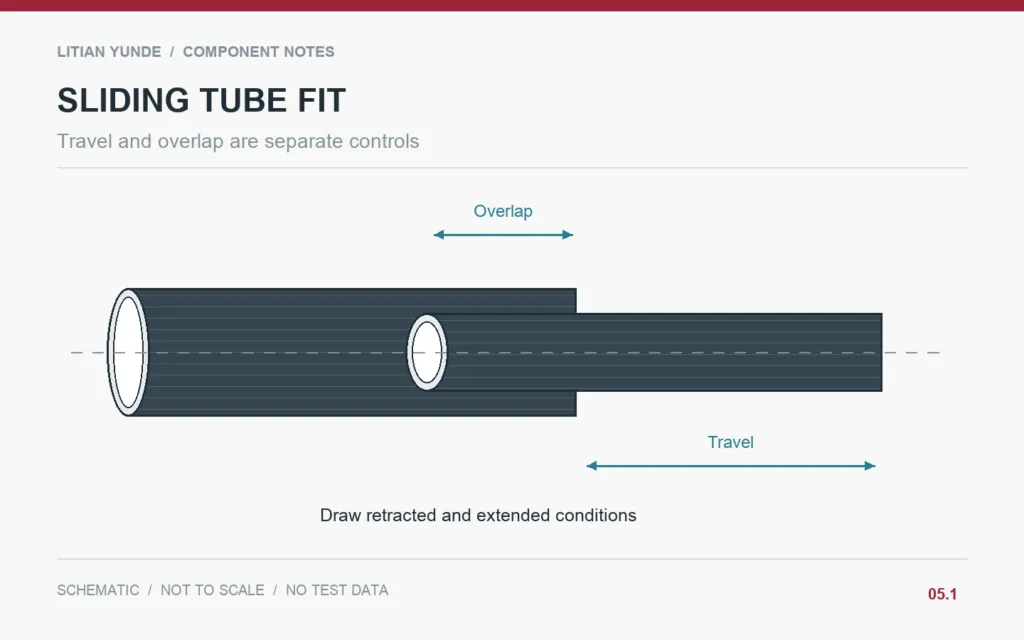
Travel and overlap are separate controls. Original explanatory schematic; not to scale and not a product test result.
Telescoping carbon fiber tubes should be reviewed as a matched sliding assembly, not as two nominal diameters. Define the stroke, overlap, guide elements, surface condition and acceptable movement. A fit at one end does not establish smooth travel through the whole operating range.
Map the travel and overlap
Show the fully retracted and extended positions, minimum retained overlap and any stop or locking feature. The engineering design must establish the safe configuration for the intended loads. Keep the functional travel check separate from that design verification. A pair that slides freely on a bench can still be unsuitable for the operating duty or load case.
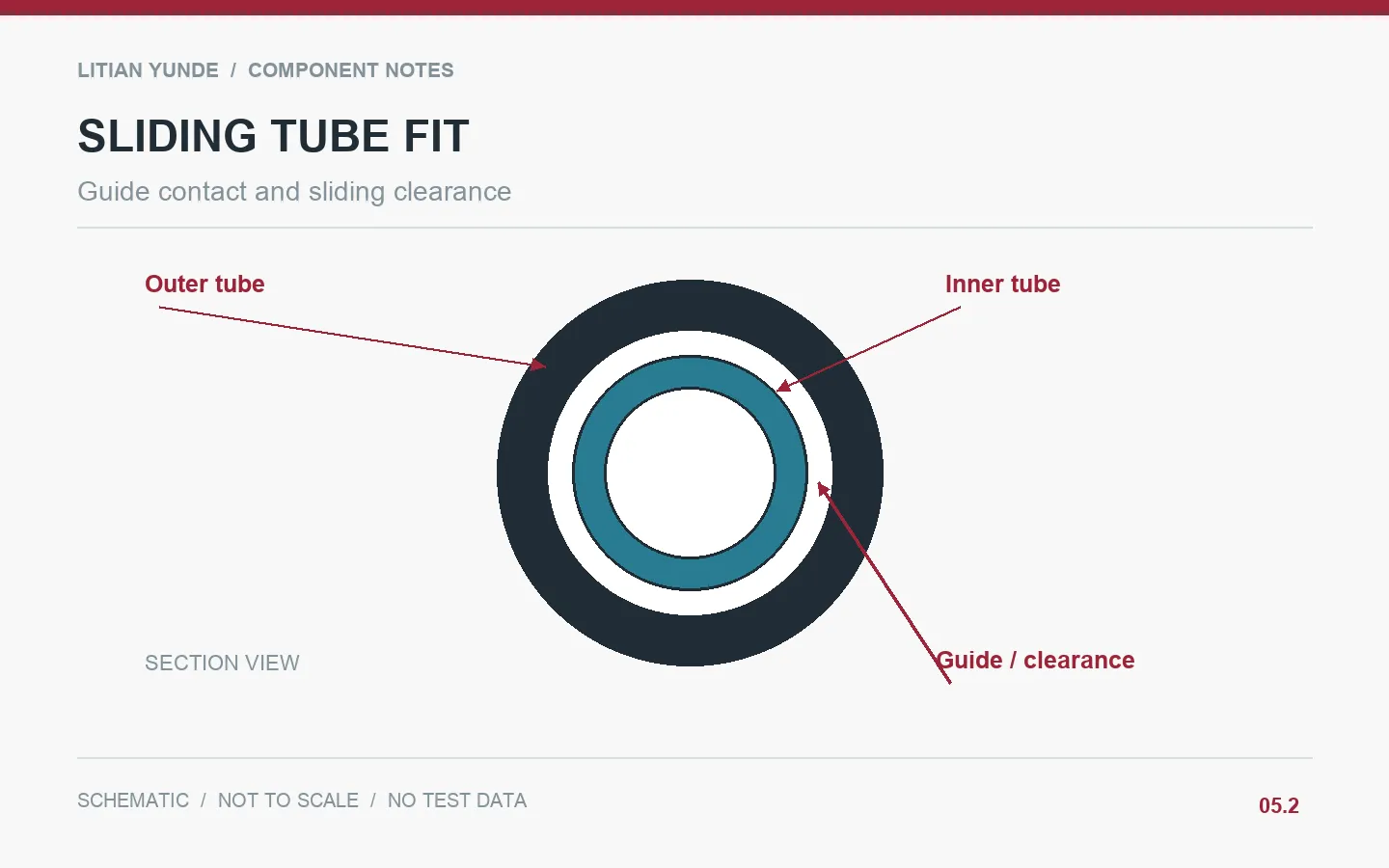
Identify what actually controls the clearance
The working fit may be between tube surfaces, replaceable bushes or guide pads. State which dimensions are controlled and whether they apply before or after finishing. Local diameter variation, alignment and surface features can affect movement. Agree where measurements are taken rather than comparing a single outside diameter with a single inside diameter.
Test the assembled travel condition
Define the orientation, environment, cleanliness and load condition used for the movement check. Record the intended sliding resistance, play or other acceptance criteria without inventing a universal clearance. If the assembly includes a lock, inspect sliding and locked states separately. Retain the identity of the paired components when matched sets are supplied.
Example: an adjustable inspection mast
A sample extends easily for the first part of its travel but catches near full extension. The review records the position of the catch, checks the guide contact and compares the two tubes along their lengths. The revised acceptance plan includes a full-stroke movement check in the specified orientation, plus a separate lock and overlap review.
Illustrative scenario, not a customer case or reported production result.
Details to agree before ordering
| Review item | Record to agree |
|---|---|
| Operating envelope | Stroke, overlap, stops and intended load conditions. |
| Sliding surfaces | Direct contact, bushes or pads; final surface finish. |
| Movement criteria | Method for checking travel, resistance and play. |
| Pair identification | Tube pair, guide configuration and drawing revision. |
Questions buyers ask
Is there one recommended clearance for all carbon tubes?
No. Clearance depends on geometry, guides, finish, environment and the assembly requirements.
Does free sliding prove the mast is structurally safe?
No. Structural validation and functional movement inspection answer different questions.
Technical background and related reading
Background resource: Hexcel: Prepreg Technology. The project checklist and example above are editorial guidance; this reference does not certify a Litian Yunde component.
- Carbon Fiber Tube RFQ: Inside Diameter, Outside Diameter and Wall
- Carbon Fiber Tube Clocking: Aligning Features at Opposite Ends
- Browse the carbon fiber knowledge centre
Review your component with Litian Yunde
Share the drawing revision, intended application and the interface or inspection question you need to resolve. The quoted construction and acceptance requirements are confirmed for the specific project.