

Catalogue references of automotive interior trim components.
Carbon fiber trim and a structural replacement can share a similar surface pattern but have different responsibilities. State the part’s function explicitly before comparing quotations or product descriptions.
Identify what the part replaces
A decorative overlay may fit over an existing component; a replacement panel may remove it. Show that distinction in the enquiry and identify the original part number or platform version. Include any adhesive, clips or brackets that are part of the supplied assembly.
Avoid transferring claims between categories
Surface finish and fit can be assessed on a trim sample. They do not demonstrate structural performance or crash behaviour. If the proposed item changes a load-bearing function, identify the responsible engineering review and required evidence before approving it as an equivalent replacement.
Example scenario
An overlay is priced as a decorative cover while the buyer expects it to replace the original panel. State whether the original part stays in place and identify the complete fixing arrangement. The two proposals should not be compared as the same item.
Points to record
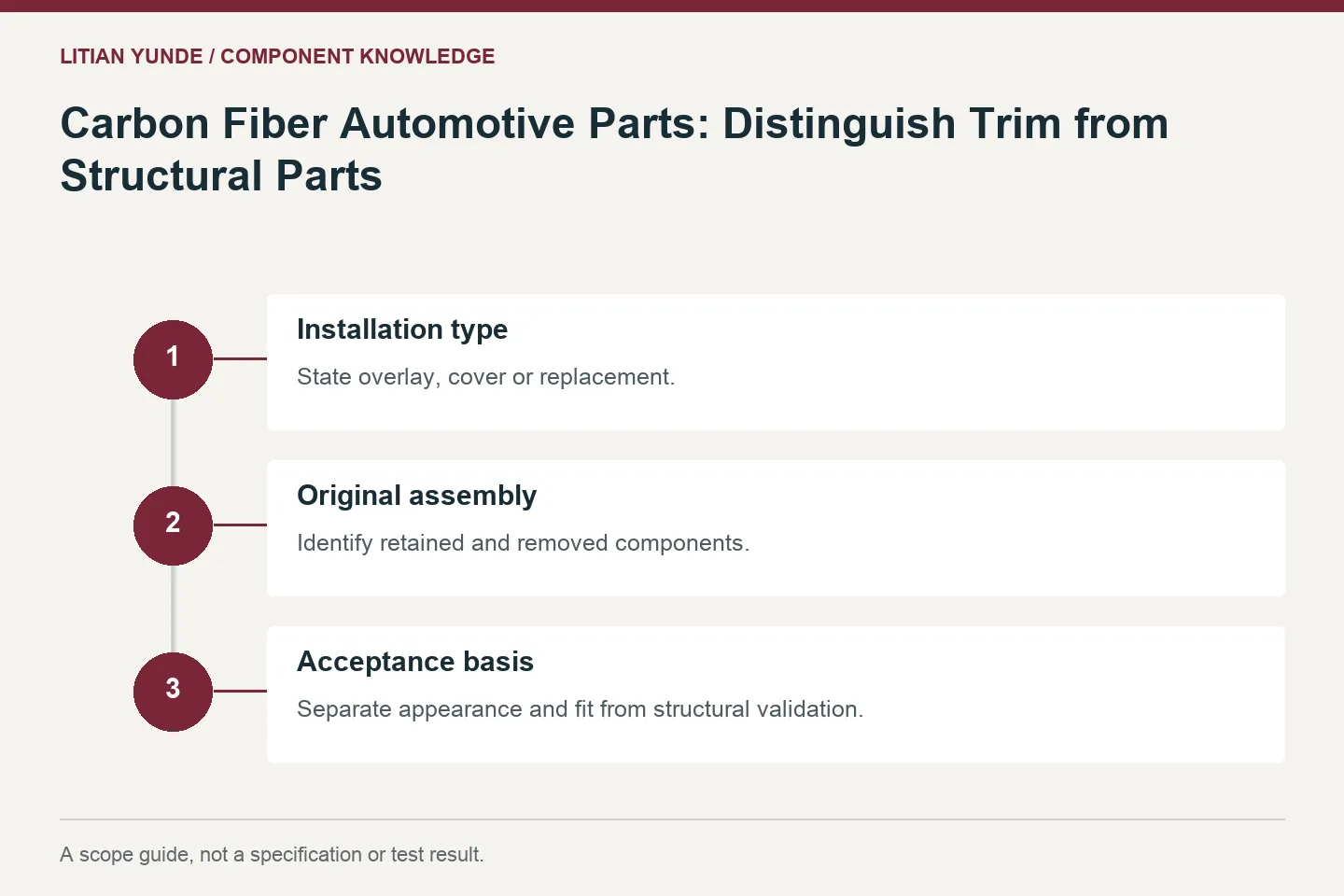
| Installation type | State overlay, cover or replacement. |
|---|---|
| Original assembly | Identify retained and removed components. |
| Acceptance basis | Separate appearance and fit from structural validation. |
Related reading
- Automotive Carbon Fiber Trim: Fitment Information a Supplier Needs
- Carbon Fiber Mirror Covers: Separating Shape, Fit and Finish
Background reference: Gurit — Composite Materials.
Discuss the component requirements
Send the part drawing and the requirements relevant to this guide for a scope review.
Contact Litian Yunde