
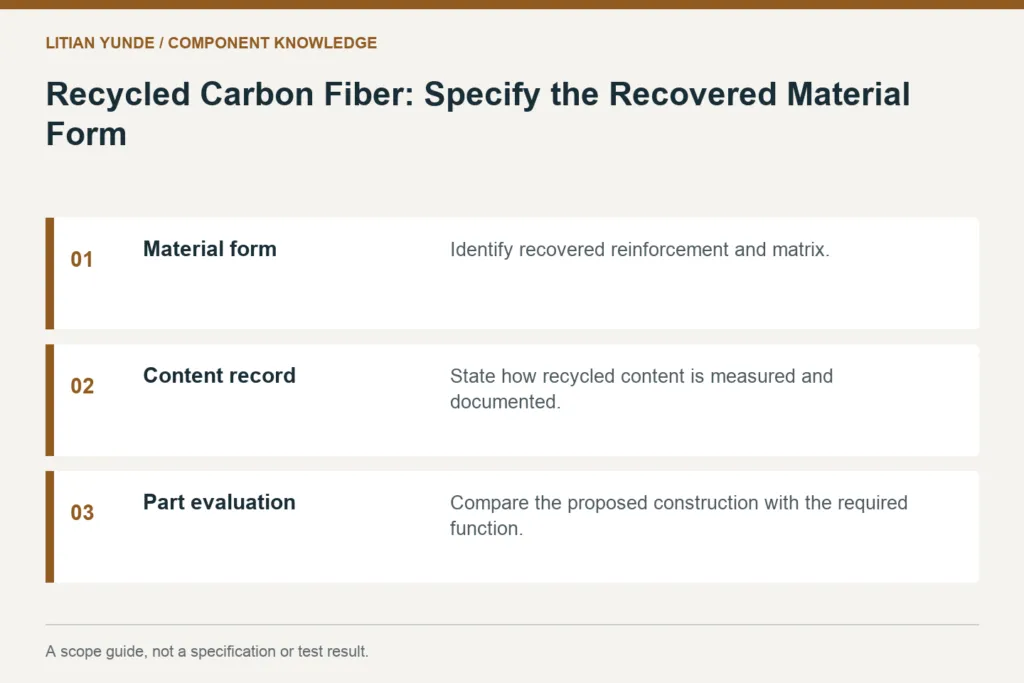
Editorial scope guide. The points are also available as readable text below.
Recycled carbon fiber is not a single interchangeable material. An enquiry should identify the recovered form and the proposed composite construction before comparing it with an existing part.
Ask for the actual material description
Specify whether the proposal uses chopped fibre, a mat or another identified reinforcement form, and record the matrix and supplied condition. Ask how recycled content is defined and documented. A broad recycled-carbon label is not enough to establish equivalence with a continuous-fibre laminate.
Review the proposed part as a new configuration
Compare the relevant processing, geometry and acceptance requirements for the intended application. Keep the evidence tied to the offered construction. Composites UK notes that recovered fibres are not generally a drop-in replacement for virgin materials; the finished design needs its own review.
Example scenario
A proposal replaces continuous-fibre laminate with a recovered-fibre mat construction. Document it as a material and construction change, then agree the relevant part evaluation. Similar colour and thickness are not a sufficient basis for treating it as an unchanged supply.
Points to record
| Material form | Identify recovered reinforcement and matrix. |
|---|---|
| Content record | State how recycled content is measured and documented. |
| Part evaluation | Compare the proposed construction with the required function. |
Related reading
- Carbon Fiber Sustainability Claims: Ask for the Comparison Basis
- Reading a Carbon Fiber Material Datasheet Without Overextending Its Claims
Background reference: Composites UK — Sustainability Good Practice Guide.
Discuss the component requirements
Send the part drawing and the requirements relevant to this guide for a scope review.
Contact Litian Yunde