
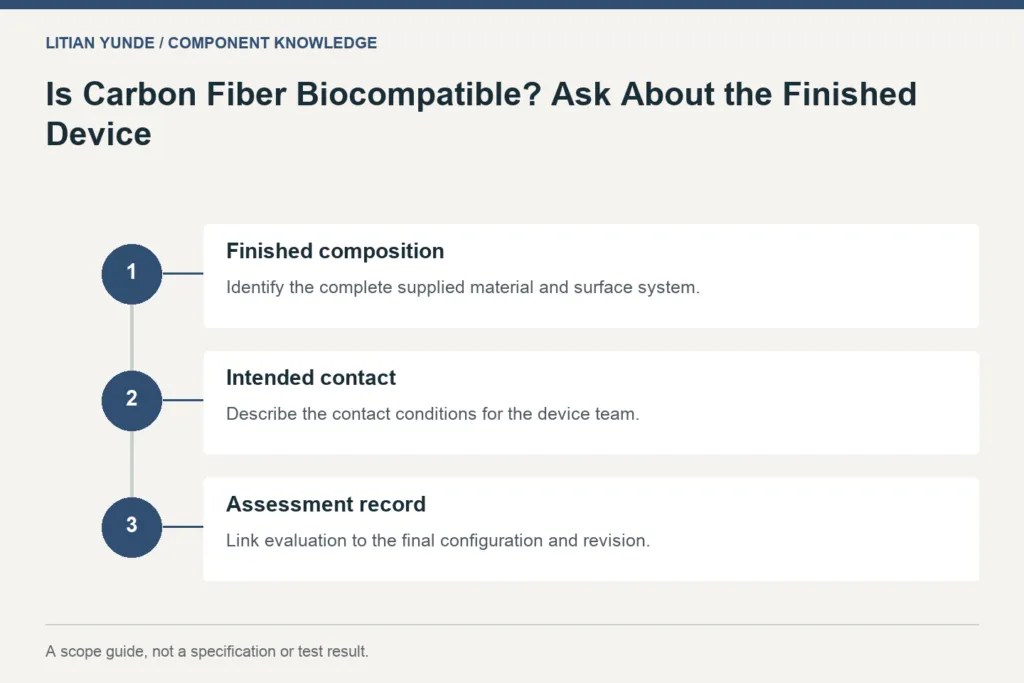
Editorial scope guide. The points are also available as readable text below.
The phrase carbon fiber does not establish biocompatibility. A device assessment must consider the finished configuration and its intended contact conditions, including the other materials present.
Identify more than the reinforcement
A finished component may include resin, coating, adhesive, cleaning residues and attached items. Give the responsible device team the actual material and processing information rather than only a fibre trade name. Identify the supplied revision so that later changes are visible.
Use the right level of evidence
FDA guidance addresses the final finished medical device rather than approving a material name in isolation. Ask the device manufacturer which assessment and supporting records are required for the intended use. This article is a documentation guide; it does not claim that any listed carbon fiber product is cleared for medical use.
Example scenario
A raw-material supplier provides a data sheet, but the finished device adds a coating and a cleaning process. Give the device team the complete configuration. The material document remains useful input without being presented as approval of the final device.
Points to record
| Finished composition | Identify the complete supplied material and surface system. |
|---|---|
| Intended contact | Describe the contact conditions for the device team. |
| Assessment record | Link evaluation to the final configuration and revision. |
Related reading
- Carbon Fiber Medical Equipment Parts: Define the Supplied Scope
- Composite Medical-Equipment Covers: Review Cleaning and Access
Background reference: FDA — Basics of Biocompatibility.
Discuss the component requirements
Send the part drawing and the requirements relevant to this guide for a scope review.
Contact Litian Yunde