
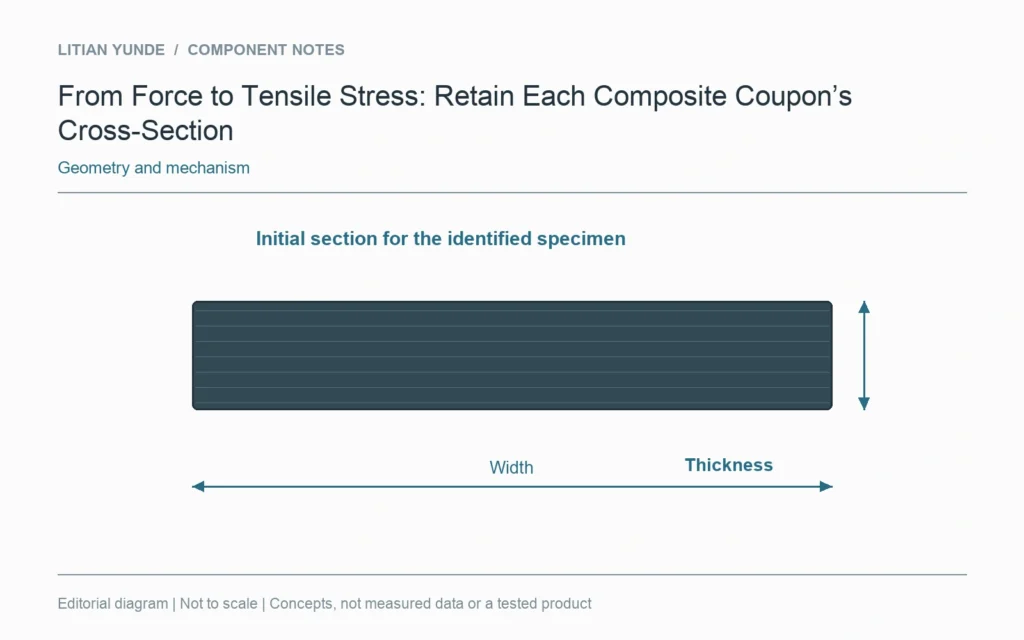
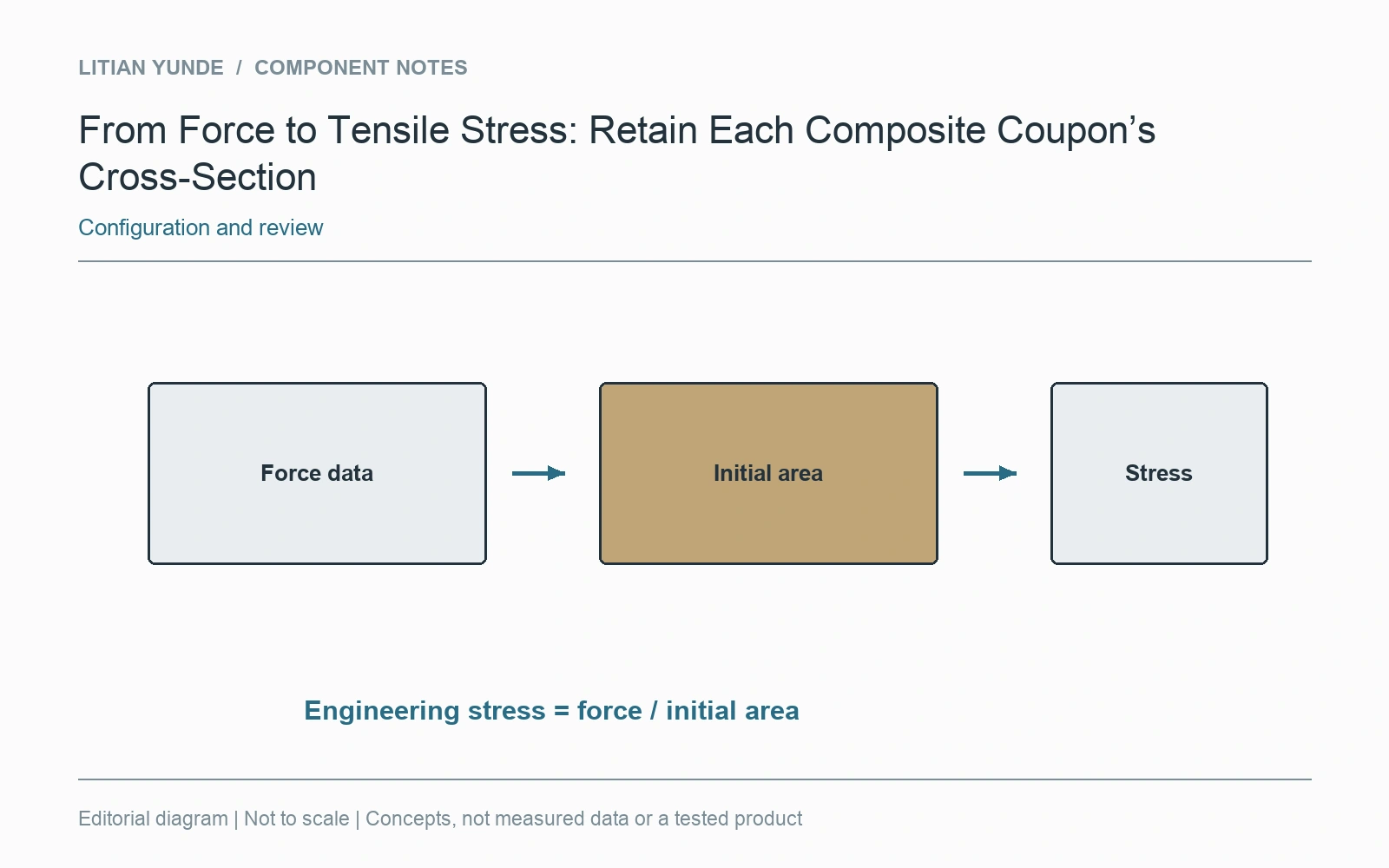
Force and tensile stress are different reported quantities. Engineering tensile stress uses the applied force and the initial cross-sectional area defined for the specimen. Keep the width, thickness and area basis with each coupon result rather than treating one nominal area as an unexplained constant.
Keep dimensions with specimen identity
Record the dimensional information required by the selected method for the actual coupon. Identify where and how those measurements were taken. A stock thickness label or a dimension from another coupon is not automatically the measured section used in the calculation.
Preserve units through the calculation
Force, area and stress need compatible units. Keep the laboratory’s calculation and reporting convention readable when moving data between systems. A new unit label on a spreadsheet does not convert the underlying values. This is especially important when comparing raw force traces with a report expressed as stress.
Compare the same reported quantity
Two coupons can carry different loads and still require a separate comparison of their normalized stresses. Conversely, similar stresses do not establish identical laminate construction or failure behaviour. Retain the method, specimen dimensions and failure record with the result, so the calculation can be followed without reconstructing it from a graph image.
Further reading: ASTM D3039: tensile-property method scope.