
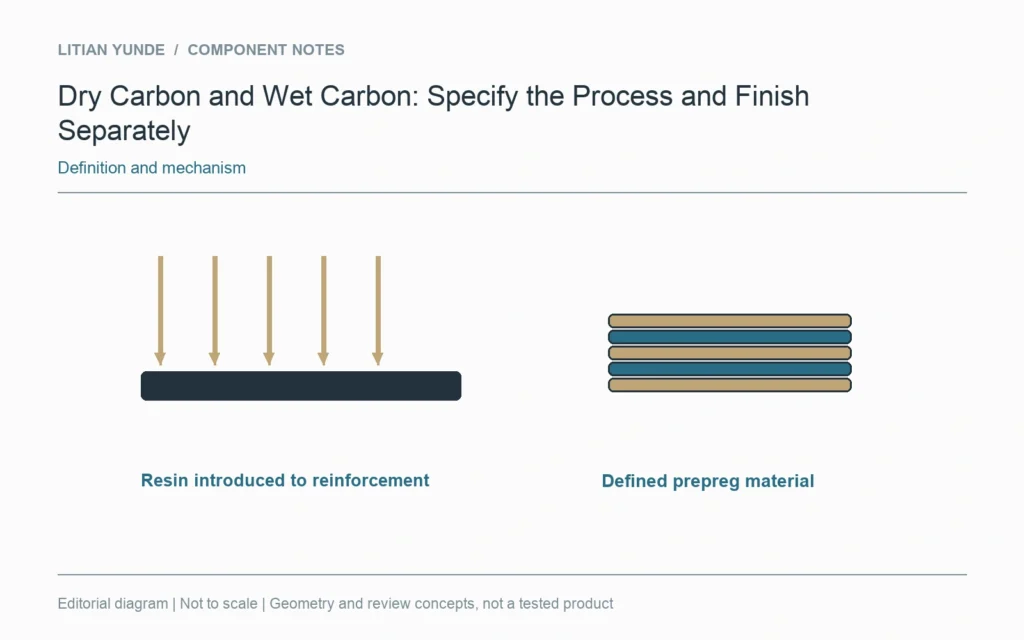
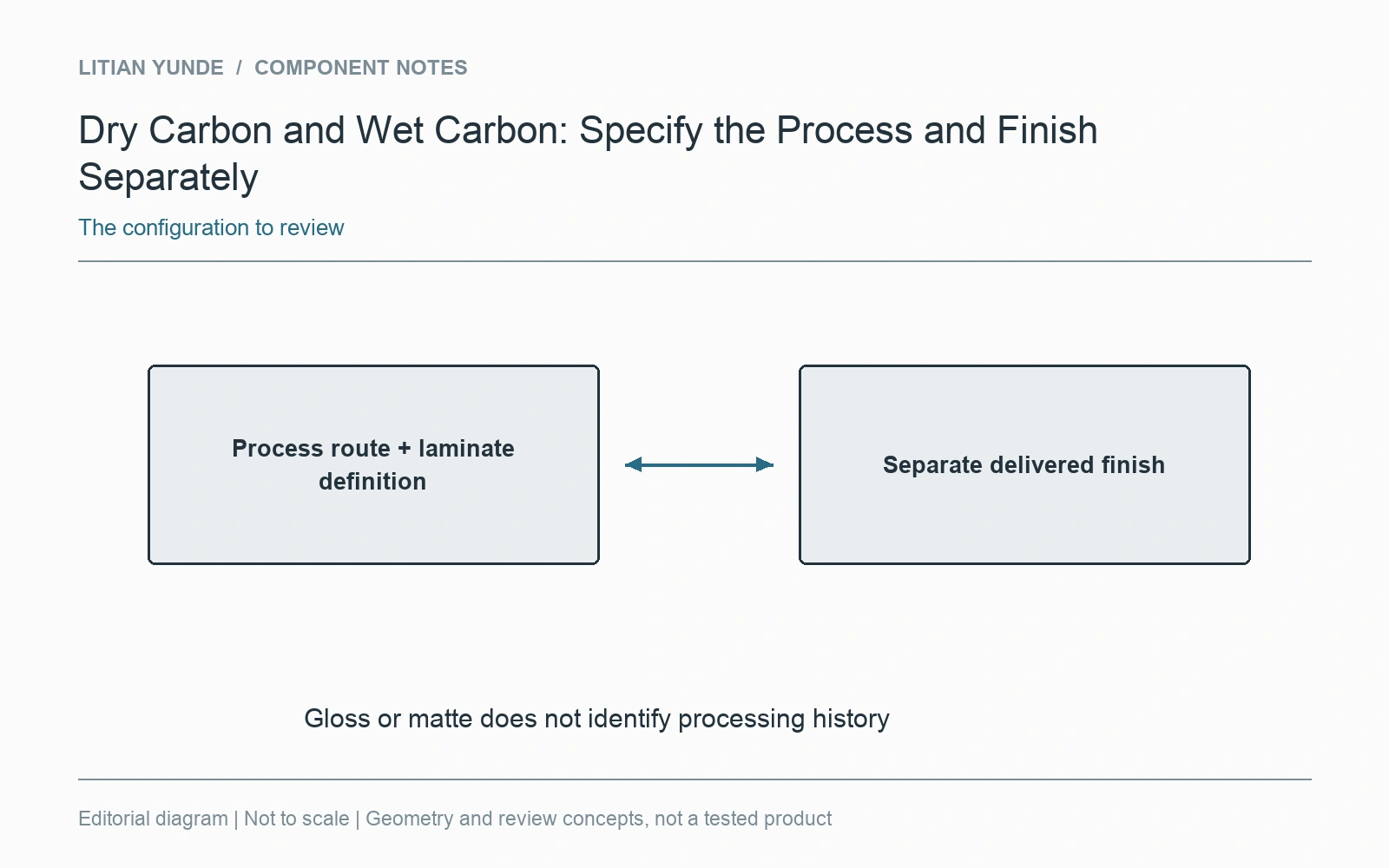
“Dry carbon” and “wet carbon” are insufficient purchase specifications on their own. Ask what manufacturing route and laminate construction the supplier proposes, then state the required surface finish separately. Appearance does not establish the processing history of a finished part.
Ask for a process description
A prepreg route starts with material containing resin, while a wet-layup route introduces liquid resin to reinforcement during manufacture. These basic descriptions still leave many project details unresolved. They do not justify assigning a universal strength, mass or quality ranking to a short marketing label.
Keep gloss out of the process definition
A glossy or matte surface is a delivered appearance condition. Coating, tooling and finishing can affect that appearance. A photograph may help establish the desired visible result, but it should not be used to prove how the internal laminate was made.
Compare the actual offer
Request the relevant material, route, finished dimensions and agreed evidence. If the quotation uses a trade label, retain its written definition with the order. Where the same component is offered through another route, review the changed scope instead of assuming the name settles equivalence. This gives both parties a usable specification without asking a cosmetic description to carry an engineering conclusion.
Further reading: Easy Composites: wet reinforcement process description.