
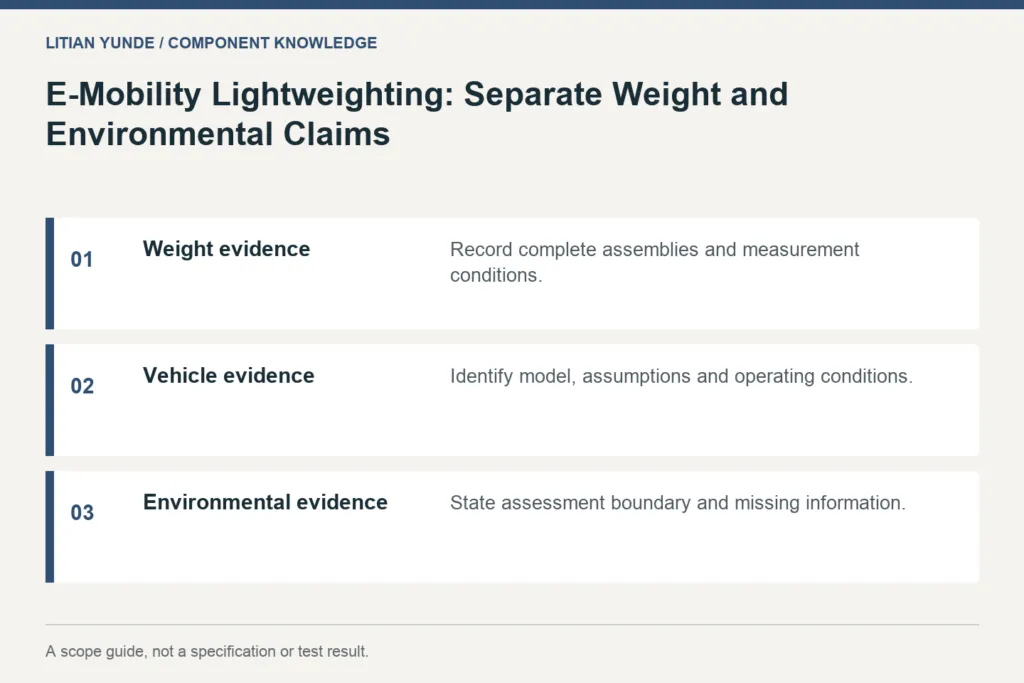
Editorial scope guide. The points are also available as readable text below.
A measured weight reduction and a lower environmental impact are different claims. Keep the evidence for each separate when assessing carbon fiber components for an e-mobility project.
Record the physical change first
Compare the complete baseline and proposed assemblies, including fasteners and finishing. Identify any changes to service life assumptions, repair arrangements or replacement intervals. A mass comparison can be useful even when a wider environmental assessment has not been completed.
Do not turn a component saving into a vehicle promise
Vehicle range depends on the complete vehicle and operating conditions. Similarly, environmental comparisons need their own boundaries and assumptions. State which outcomes have been measured, which have been modelled and which remain unknown; avoid converting a component percentage directly into a range or emissions claim.
Example scenario
A component’s mass is measured, while the proposed vehicle-range benefit comes from a model. Label these as measured and modelled results respectively, and retain the model assumptions. Neither result alone establishes the component’s full environmental impact.
Points to record
| Weight evidence | Record complete assemblies and measurement conditions. |
|---|---|
| Vehicle evidence | Identify model, assumptions and operating conditions. |
| Environmental evidence | State assessment boundary and missing information. |
Related reading
Background reference: U.S. Department of Energy — Lightweight and Propulsion Materials.
Discuss the component requirements
Send the part drawing and the requirements relevant to this guide for a scope review.
联系李天云德