
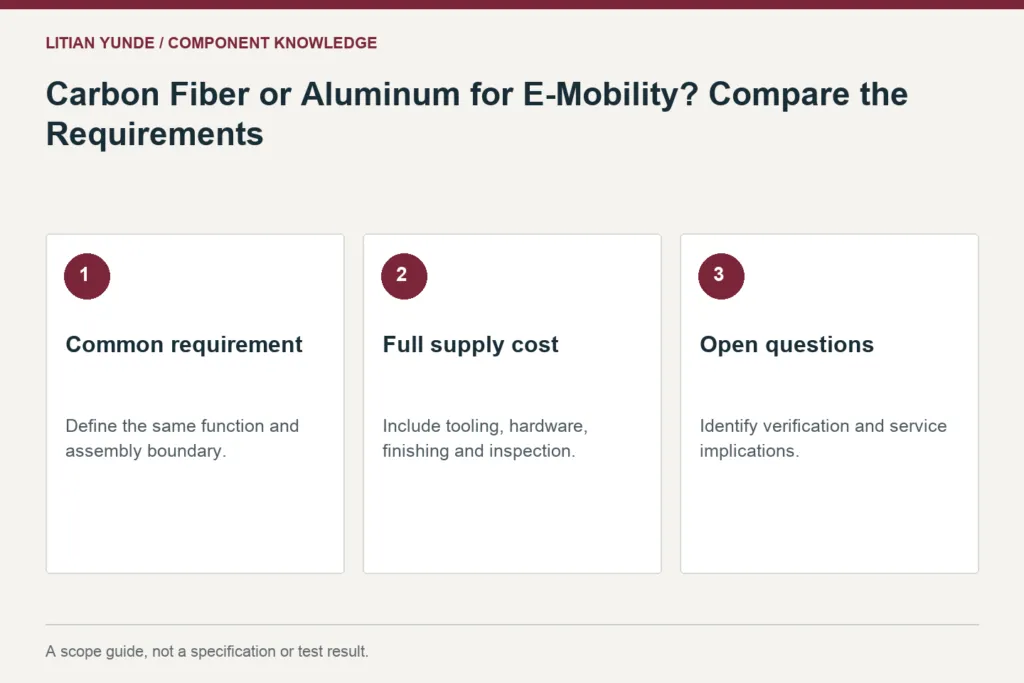
Editorial scope guide. The points are also available as readable text below.
The useful comparison between carbon fiber and aluminum starts with the component requirements. Weight, geometry, joining, production quantity and service arrangements all affect the decision; there is no universal winner.
Compare two defined proposals
Give both proposals the same function and assembly boundary. Include brackets, inserts, finishing and required checks. A raw-material density or a single coupon value is not a complete comparison of two assembled components.
Make trade-offs visible in the quotation
Record tooling, part cost, inspection scope and any design or service changes separately. Ask which assumptions would change at a different order quantity. Keep unverified performance benefits out of the decision table and identify the sample or engineering work needed to resolve them.
Example scenario
A carbon proposal includes new tooling and separate bonded fittings, while an aluminum proposal includes an assembled machined part. Compare the complete delivered scope and required verification before deciding which quotation offers better value for the intended quantity.
Points to record
| Common requirement | Define the same function and assembly boundary. |
|---|---|
| Full supply cost | Include tooling, hardware, finishing and inspection. |
| Open questions | Identify verification and service implications. |
Related reading
Background reference: U.S. Department of Energy — Lightweight and Propulsion Materials.
Discuss the component requirements
Send the part drawing and the requirements relevant to this guide for a scope review.
联系李天云德