

Механическая обработка и сборка · Руководство по проверке компонентов · Litian Yunde
Концепт, созданный с помощью искусственного интеллекта; это не фотография продукта компании Litian Yunde и не утвержденный дизайн.
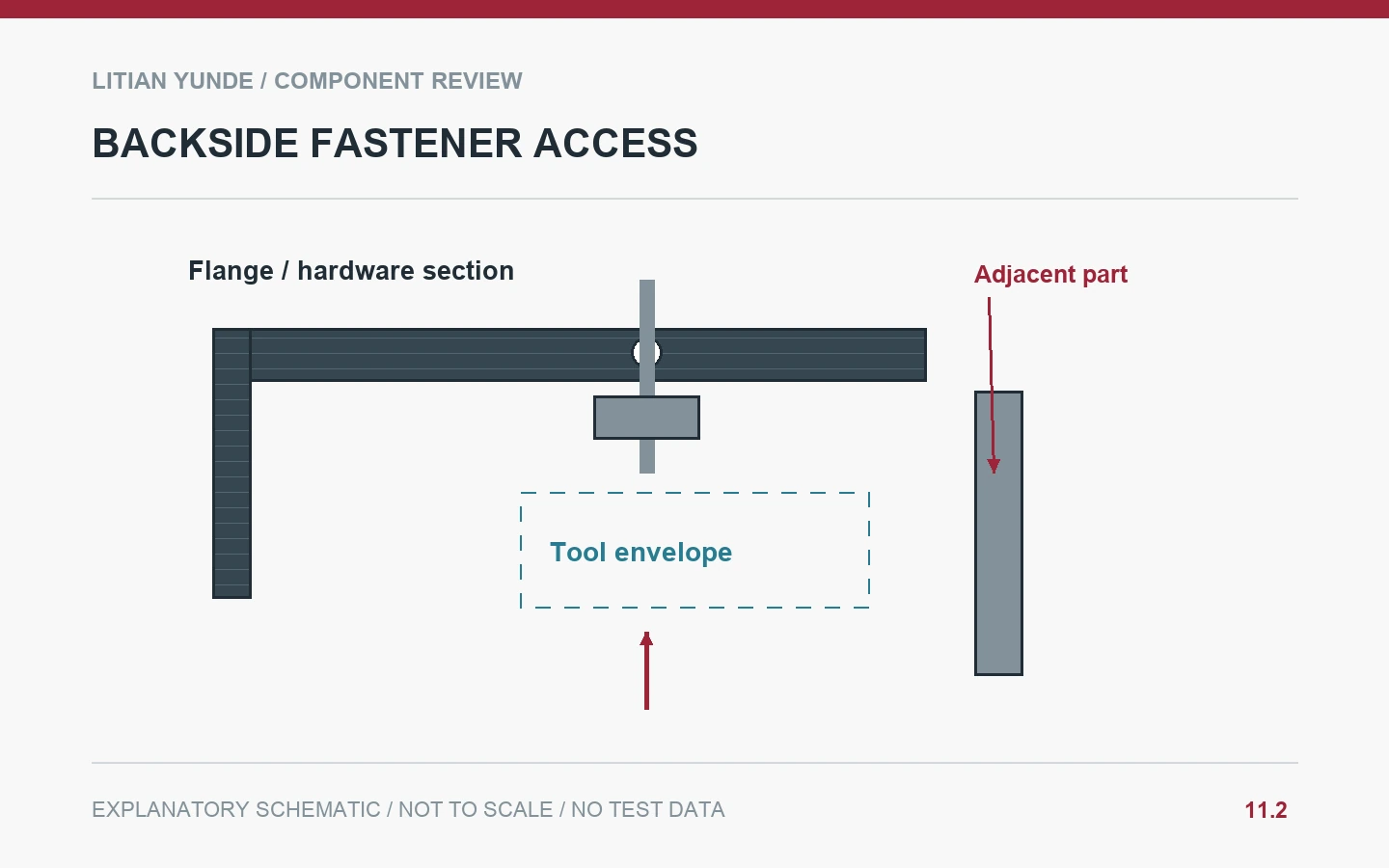
A visible fastener hole does not prove a shell flange can be assembled. Check where the nut or retainer sits, how a tool reaches it and whether neighbouring parts block access. Review the installation and removal sequence before accepting the flange geometry, especially when the completed equipment encloses its underside.
Show both sides of the connection
Provide a section or assembly view that includes the flange, mating bracket, fastener, washer and retainer. A top view can conceal a return edge or a neighbouring wall beneath the joint. Identify the hardware configuration that governs the space. Do not substitute a guessed fastener head or washer profile in the review. If a captive retainer is proposed, define its supplied scope and how it is located.
Check the working envelope of the tool
Allow for the tool actually used to hold and turn the hardware, including the approach and withdrawal route. A static gap around a nut may not allow the intended socket or spanner to reach it. Review whether surrounding parts must be installed later or temporarily removed. Do not count on bending the flange or using uncontrolled assembly force to create tool space. The approved method should be feasible without changing the part.
Repeat the review for service removal
Installation access can disappear after cables, trays or adjacent covers are fitted. If the fastener is intended to be removed in service, check the complete service configuration and explain which items must first be removed. A permanent captive component needs its own replacement route. Fit confirmation and tool-access checks belong in the assembly record; neither supplies an unverified clamp load or structural rating for the flange.
Example: the trapped washer
A sample shell fits its bracket, but a washer cannot be placed behind the flange once the internal tray is installed. The team revises the controlled assembly sequence and reviews whether service removal remains possible. The solution is documented instead of leaving installers to omit the washer or enlarge the hole.
Это примерный сценарий, а не реальный случай из практики клиента или официально опубликованные производственные результаты.
Детали, которые необходимо согласовать перед оформлением заказа
| Обзор товара | Зафиксировать для согласования |
|---|---|
| Section | Both sides of flange and mating hardware. |
| Tools | Approach, turning and withdrawal envelope. |
| Sequence | Parts installed before and after fastening. |
| Сервис | Removal route in completed equipment. |
Вопросы, которые задают покупатели
Can a tool-clearance problem be solved by omitting a washer?
Only an authorised connection change can alter the specified hardware. Record the interference and obtain disposition.
Does tightening the screw prove the flange joint is valid?
It shows an assembly action. The connection still needs its agreed fit, method and performance evidence.
Техническая информация и рекомендуемая литература
Справочный материал: Hexcel: Ресурсы по инженерии композитных материалов. Только для ознакомления; контрольный список проекта является редакционным руководством, и данный документ не служит основанием для сертификации поставщика или утверждения деталей.
- Проходные отверстия и зенковки в углеродном волокне: определение места крепления
- Крышки из углеродного волокна с уплотнителями: определение состояния сжатия в установленном состоянии
- Ознакомьтесь с информационным центром по углеродному волокну
Обсудите свой компонент с Литянь Юнде
Сообщите нам о внесениях в чертеж, предполагаемом применении, а также о вопросах, касающихся интерфейса или приемки, которые необходимо решить. Приведенные требования к конструкции и приемке подтверждены для данного конкретного проекта.