

An opening in a carbon fiber shell may be formed during moulding, trimmed afterward or made through a combined route. The finished opening still needs a dimensional and surface definition. Discuss the proposed route without assuming it produces an identical edge condition.
Specify the finished feature first
Locate the opening and identify the mating part, seal or clearance it serves. Define the relevant face and required edge condition. A moulding boundary, trim line and finished opening are not necessarily the same geometric reference.
Review access and local construction
The manufacturing review needs to consider how the feature can be formed or reached for trimming. Local reinforcement and tight internal geometry may also affect the proposal. These are project questions, not a claim that one route always produces a stronger or more accurate opening.
Agree what the sample proves
Check the actual opening with its mating arrangement and the agreed inspection references. Record whether the sample represents the proposed repeat-production route. If the route changes after approval, review whether the accepted evidence still applies. A quotation should also identify which operations are included, so a shell supplied with trimming allowance is not mistaken for a ready-to-assemble finished component.
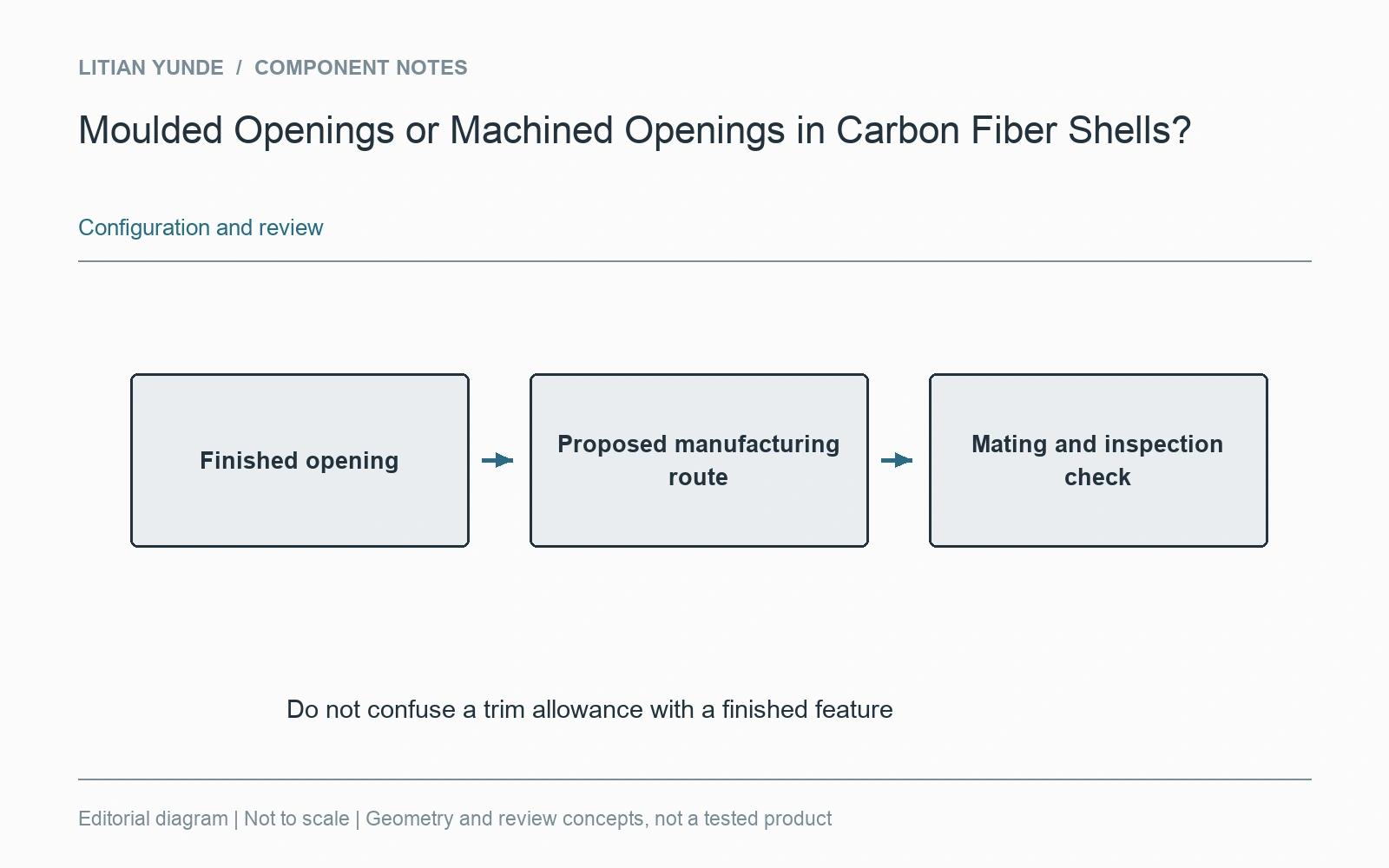
For the project review: finished opening and mating requirement; moulding boundary versus trim reference; tool access and local construction; sample route and included operations.