

Plates & Panels · Component review guide · Litian Yunde
Measure the finished interface. Original explanatory schematic; not to scale and not a product test result.
Una única lectura del espesor no describe todas las zonas de un panel de fibra de carbono. Acuerda un mapa de mediciones e indica si se incluyen el recubrimiento, los refuerzos locales y el tratamiento de los bordes. Establece un requisito local específico cuando un componente de acoplamiento dependa del espesor.
Distinguish nominal stock from a finished interface
A stock designation is useful for ordering material, but the finished part may include machining, surface finish or local features. If a slot, rail or fastener grips the panel, show the interface on the drawing. Identify which surfaces define the measured thickness. Otherwise one team may measure the bare laminate while another measures the painted finished part.
Build a repeatable measurement map
Mark accessible points across the panel and the regions around functional features. Choose contact geometry and measuring force suitable for the surface, then document the method. Avoid treating a reading on a rough edge as interchangeable with a reading between finished faces. A labelled map makes the inspection repeatable and helps distinguish a local issue from a broader pattern.
Do not hide extremes inside an average
An average may support a process review, but an interface can still fail at the thickest or thinnest relevant point. Report individual readings where local limits apply. Keep local reinforcement zones separate from uniform-thickness zones. The purchasing document should say which requirements are local, which describe an overall range and which are informational only.
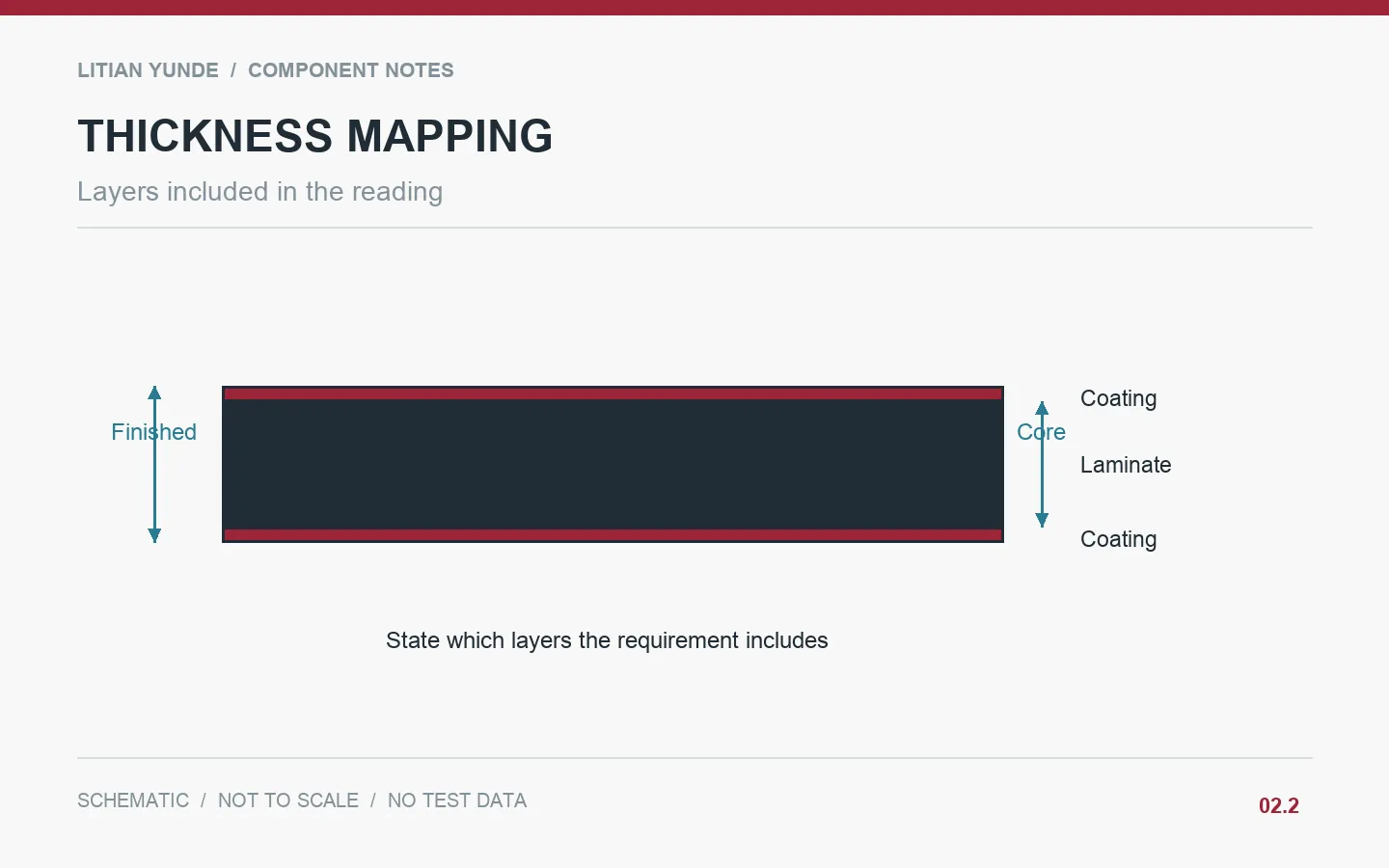
Example: a sliding panel in guide rails
A panel slides into two edge rails. Measurements at its centre meet the nominal description, but a finished edge does not enter one rail. The buyer adds measurement points along both sliding edges and states that the coating is included. The centre measurements remain in the report, but the rail fit is judged against its own functional requirement.
Illustrative scenario, not a customer case or reported production result.
Details to agree before ordering
| Artículo de reseña | Record to agree |
|---|---|
| Included layers | Laminate, paint, clear coat, pads or local reinforcement. |
| Point map | Label each location and specify the measurement side. |
| Instrument setup | Contact shape, access and agreed measurement force. |
| Report format | Individual results and local limits, not only an average. |
Questions buyers ask
Should every panel have the same measurement grid?
No. Place points around the interfaces and geometry that control the application.
Is a nominal thickness a tolerance?
No. A nominal value needs an agreed allowable variation and inspection method.
Technical background and related reading
Background resource: NIST: Measurement Process Characterization. The project checklist and example above are editorial guidance; this reference does not certify a Litian Yunde component.
- Cómo especificar sin ambigüedades la disposición de los orificios de una placa de fibra de carbono
- Planicidad de las placas de fibra de carbono: mediciones en estado libre y montadas
- Browse the carbon fiber knowledge centre
Review your component with Litian Yunde
Share the drawing revision, intended application and the interface or inspection question you need to resolve. The quoted construction and acceptance requirements are confirmed for the specific project.