
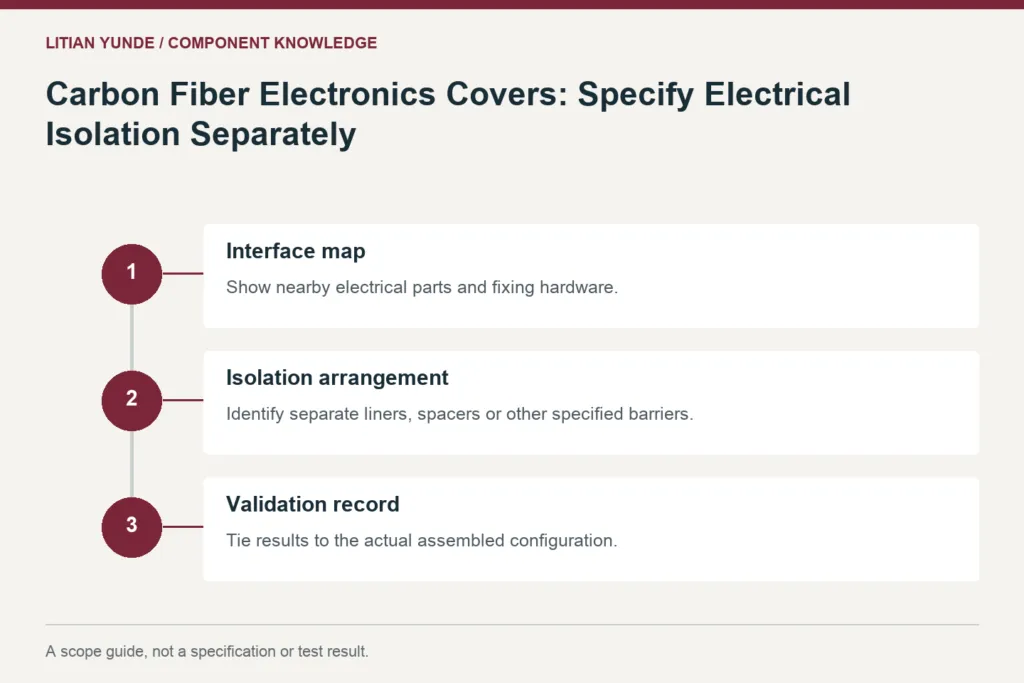
Editorial scope guide. The points are also available as readable text below.
A carbon fiber cover should not be assumed to provide electrical insulation. Define the isolation requirements and the complete assembly arrangement with the electronics team before releasing its geometry.
Identify potential contact locations
Show the board, terminals, cables, inserts and fasteners near the cover. Carbon fibre’s conductivity means these interfaces need deliberate review. A coating or liner should be identified as a separate material and configuration rather than treated as an undefined property of the shell.
Agree who validates the assembly
Specify the relevant checks through the responsible electrical design team and keep the evaluated sample representative of production. Do not infer an insulation rating from a glossy finish or a generic material description. Later changes to fasteners, cut-outs or liners should be reviewed against the same requirements.
Example scenario
A cover is evaluated with an insulating liner, then a later drawing omits the liner from the supplied assembly. Flag this as a configuration change for electrical review. The earlier result should not be cited as evidence for the unlined version.
Points to record
| Interface map | Show nearby electrical parts and fixing hardware. |
|---|---|
| Isolation arrangement | Identify separate liners, spacers or other specified barriers. |
| Validation record | Tie results to the actual assembled configuration. |
Related reading
- Запрос по проектированию электронного отсека для БПЛА: доступ — превыше всего
- Соединения углеродного волокна и металла: что должно быть указано в запросе предложений
Background reference: Toray Composite Materials America — Carbon Fiber.
Discuss the component requirements
Send the part drawing and the requirements relevant to this guide for a scope review.
Связаться с «Литянь Юньдэ»