

A fitting on a tapered tube needs a location as well as a diameter. Move the fitting along the member and the local section changes. A dimension taken at the small end does not describe the place where a bracket will actually sit.
Give each interface a station
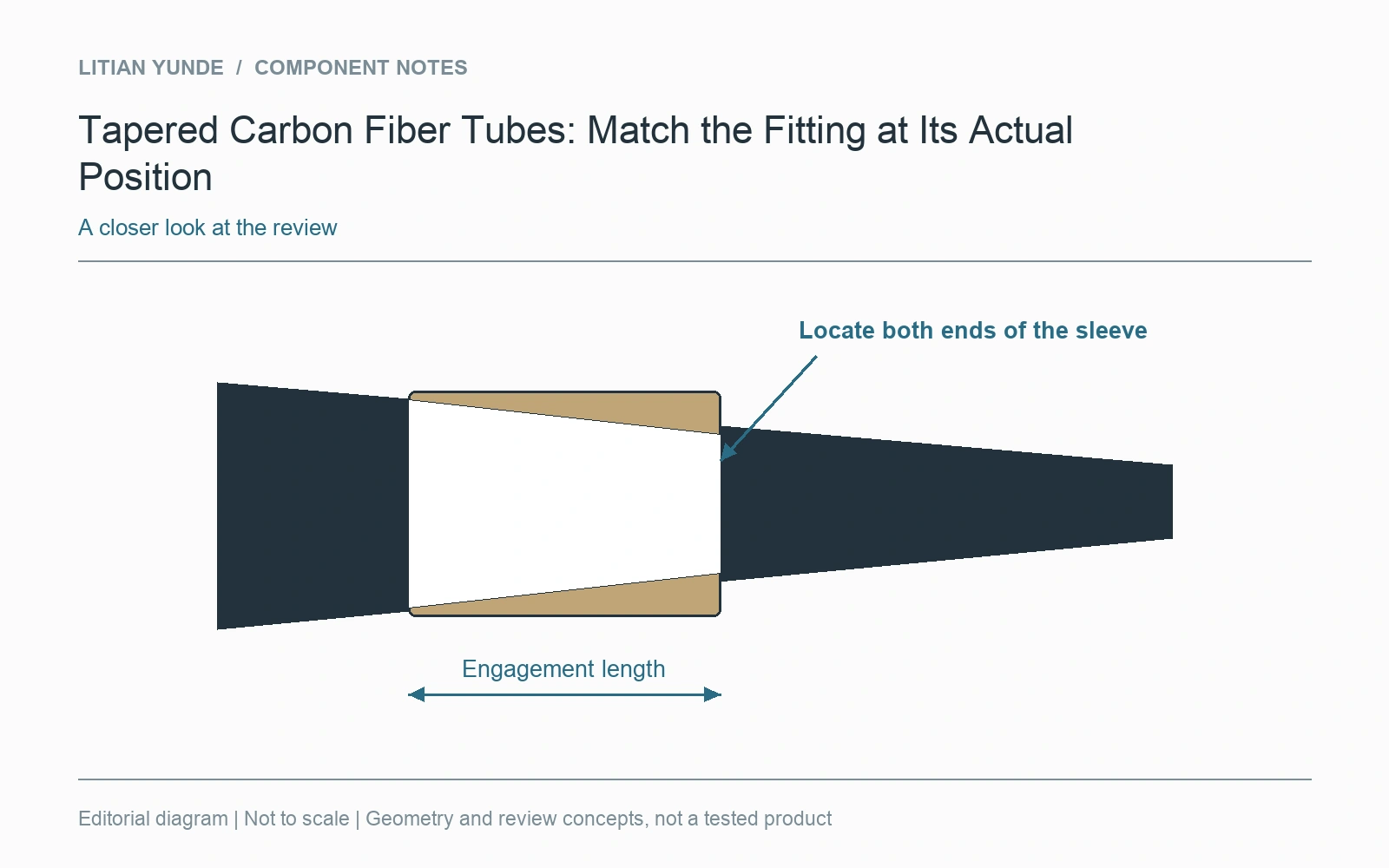
Use a reference end and specify the distance to each attachment. At that station, describe the local outside shape and any orientation feature. If a sleeve engages a length of taper, show both its start and finish positions. This makes clear whether the interface is a short collar or a longer matching surface.
A cone description may still be incomplete
Some tubes have a simple, nearly linear taper, while others have changes in section along their length. Do not assume the complete profile from two end diameters unless the drawing explicitly controls that relationship. Local wall construction, finish and shape also matter at the fitting. The supplier review should confirm which dimensions describe the quoted tube.
Check what stops axial movement
A collar on a tapered surface can seat at a position that depends on geometry and assembly force. If the fitting must remain at a specific station, discuss how that position is controlled. A shoulder, matching adapter or other engineered restraint may be needed. Tightening until it “feels secure” is not a repeatable location method or proof of load capacity.
Keep the inspection convenient
Choose measurement stations that can be identified on the part without damaging the visible surface. Record whether dimensions refer to the finished outside face or an earlier manufacturing state. When checking a first sample, compare the fitting position and the local contact condition together. A correctly located bracket with poor seating and a well-seated bracket in the wrong place are both useful findings to retain.
For the project review: reference end and attachment stations; local section and engagement length; axial position control; finished-surface measurement condition.