

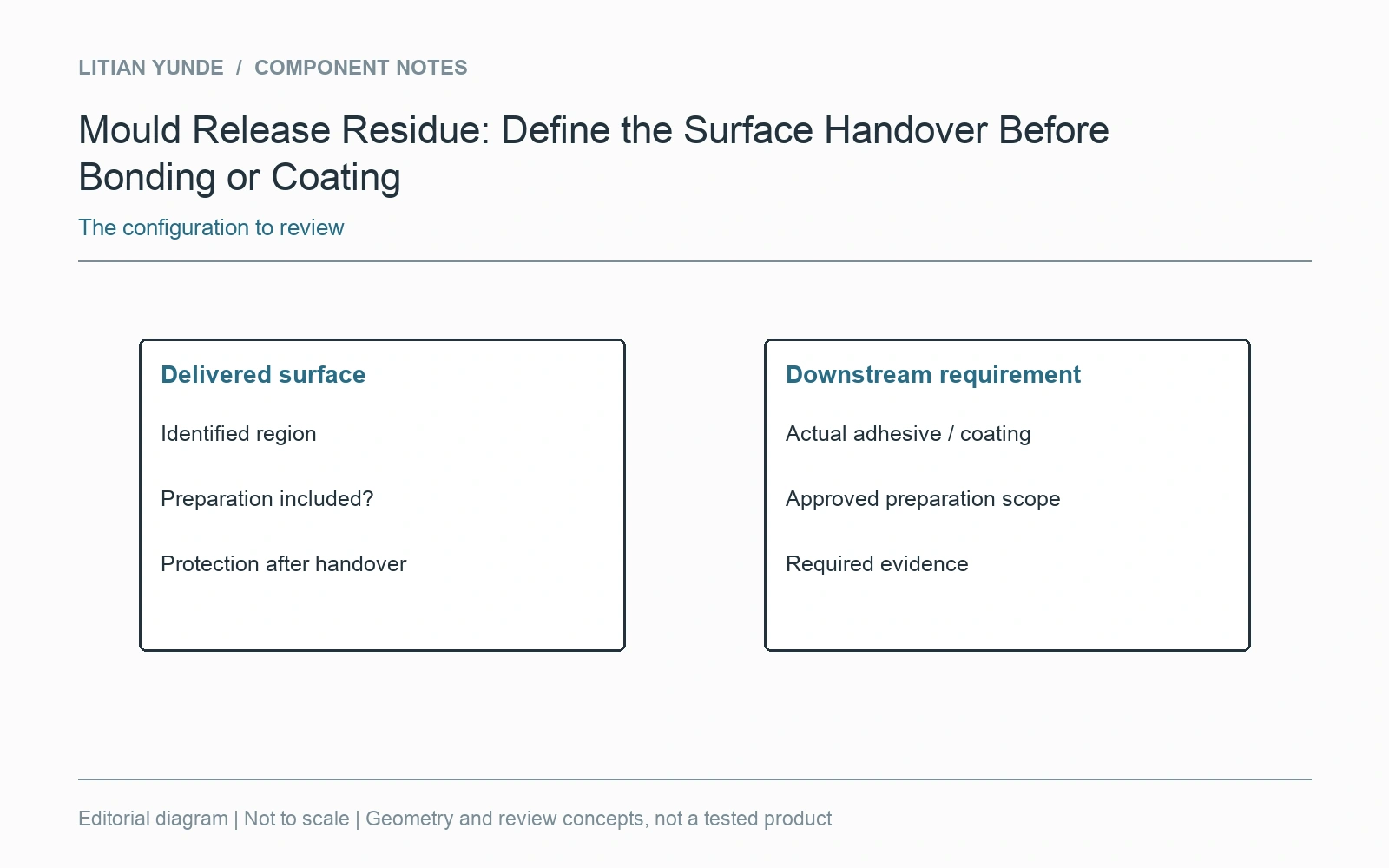
A demoulded composite surface and a surface prepared for bonding or coating are different handover states. Clarify which state the supplier is delivering. A clean-looking or glossy face does not, by itself, prove compatibility with a downstream adhesive or finish.
Identify the downstream operation
State which faces will be bonded, coated or otherwise processed after delivery. Keep functional regions separate from purely cosmetic faces. The parties need a defined handover so each does not assume the other has completed the required preparation.
Use material-specific preparation requirements
Release products, laminate systems and downstream materials need to be considered within the agreed process. Do not select a cleaning method from appearance alone or assume that one generic solvent is suitable. Ask the responsible process reviewer to define the required condition and evidence for the actual materials.
Record what is supplied
The order can identify whether a process layer remains in place, whether preparation is included and how the surface is protected afterward. Keep any required traceability with the part. A process-material declaration and a verified surface preparation are different evidence. If the product or preparation changes, review its effect on the downstream requirement instead of relying only on an unchanged cosmetic sample.
Further reading: Gurit: prepreg processing guide.