

Machining & Assembly · Component review guide · Litian Yunde
Map the surfaces by function. Original explanatory schematic; not to scale and not a product test result.
A finishing drawing should identify the areas to coat, bond, mask or leave untouched. A single colour or gloss instruction cannot describe every functional surface. Use a zone map and define the order of operations so coating does not silently change an adhesive or fit interface.
Give each zone a clear purpose
Mark the visible finish zone, bond zone, sliding face, electrical contact or identification area as separate features where applicable. State whether overspray is allowed at a boundary and how that boundary is inspected. Keep masking dimensions tied to datums. Instructions such as “keep the back clean” are difficult to reproduce on a complex or handed part.
Review the sequence before finishing
A surface intended for bonding needs the preparation required by the chosen adhesive and material system. Confirm whether bonding precedes or follows painting and who controls the surface between operations. Masking tape removal, handling and storage should not undermine the approved preparation. A visually neat coating boundary is useful but does not establish adhesive compatibility or cleanliness.
Check after the last relevant operation
Inspect the finished part for zone position, edge quality and any interference with mating components. Record the coating system where it affects a controlled interface. If a part is repainted, revisit the fit and bond zones before accepting it. Rework should restore the approved configuration rather than adding successive layers without checking their effect.
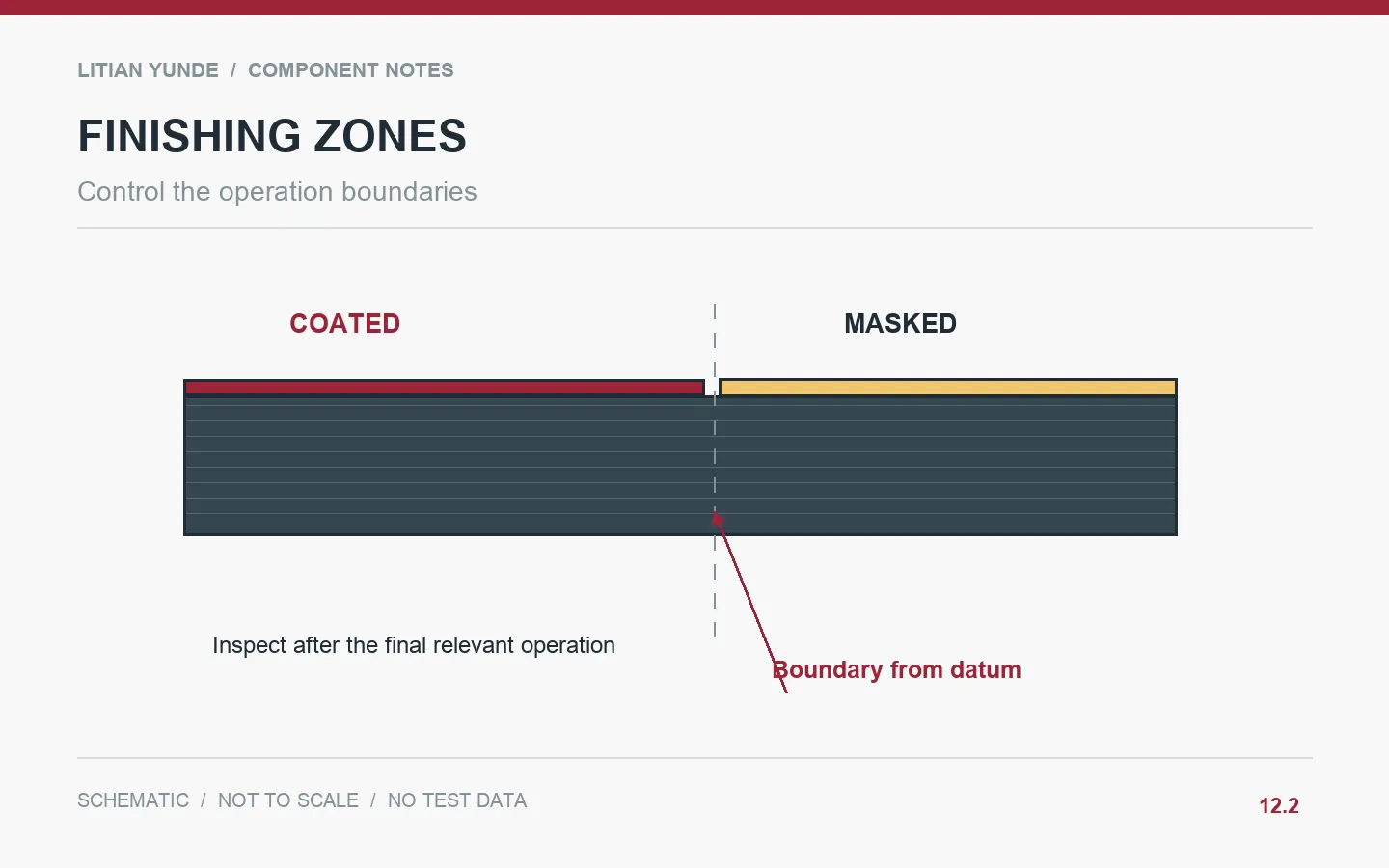
Example: a cover bonded to mounting pads
The outside of a cover requires a cosmetic coating, while small internal pads require an adhesive process. The drawing gives each pad an identified keep-clear region and specifies which operation happens first. The sample review photographs these regions before bonding and checks the final coating boundary. The record is specific to the approved finish and adhesive systems.
Beispielszenario, kein Kundenfall und kein gemeldetes Produktionsergebnis.
Vor der Bestellung zu klärende Details
| Rezensionsobjekt | Zu Protokoll nehmen, um zuzustimmen |
|---|---|
| Zone map | Named finish, bond and keep-clear areas. |
| Boundary control | Datum-based location and allowed edge variation. |
| Process sequence | Painting, preparation, bonding and handling order. |
| Rework rule | How zones and interfaces are restored and rechecked. |
Fragen, die Käufer stellen
Is masking sufficient surface preparation for bonding?
No. It preserves an area but does not replace the adhesive supplier’s preparation requirements.
Should hidden surfaces receive the same coating?
Only if the specification calls for it and the coating is compatible with their function.
Technischer Hintergrund und weiterführende Literatur
Hintergrundmaterial: WEST SYSTEM: Surface Preparation. Die oben aufgeführte Projekt-Checkliste und das Beispiel dienen als redaktionelle Orientierungshilfe; diese Angabe stellt keine Zertifizierung einer Litian-Yunde-Komponente dar.
- Freigabe eines Musters einer Kohlefaseroberfläche für Nachbestellungen
- Carbon Fiber Bonded Joints: Control Overlap and Bondline Geometry
- Entdecken Sie das Wissenszentrum zum Thema Kohlefaser
Besprechen Sie Ihre Komponente mit Litian Yunde
Teilen Sie uns die überarbeitete Zeichnung, den vorgesehenen Einsatzzweck sowie die Frage zur Schnittstelle oder zur Abnahme mit, die Sie klären möchten. Die angegebenen Konstruktions- und Abnahmeanforderungen sind für das jeweilige Projekt bestätigt.