
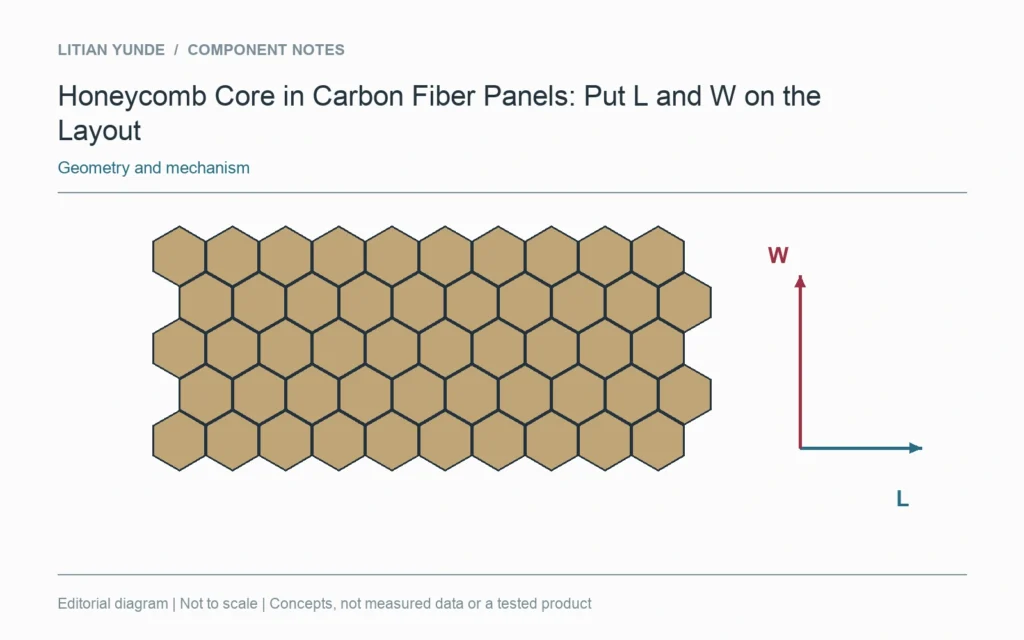
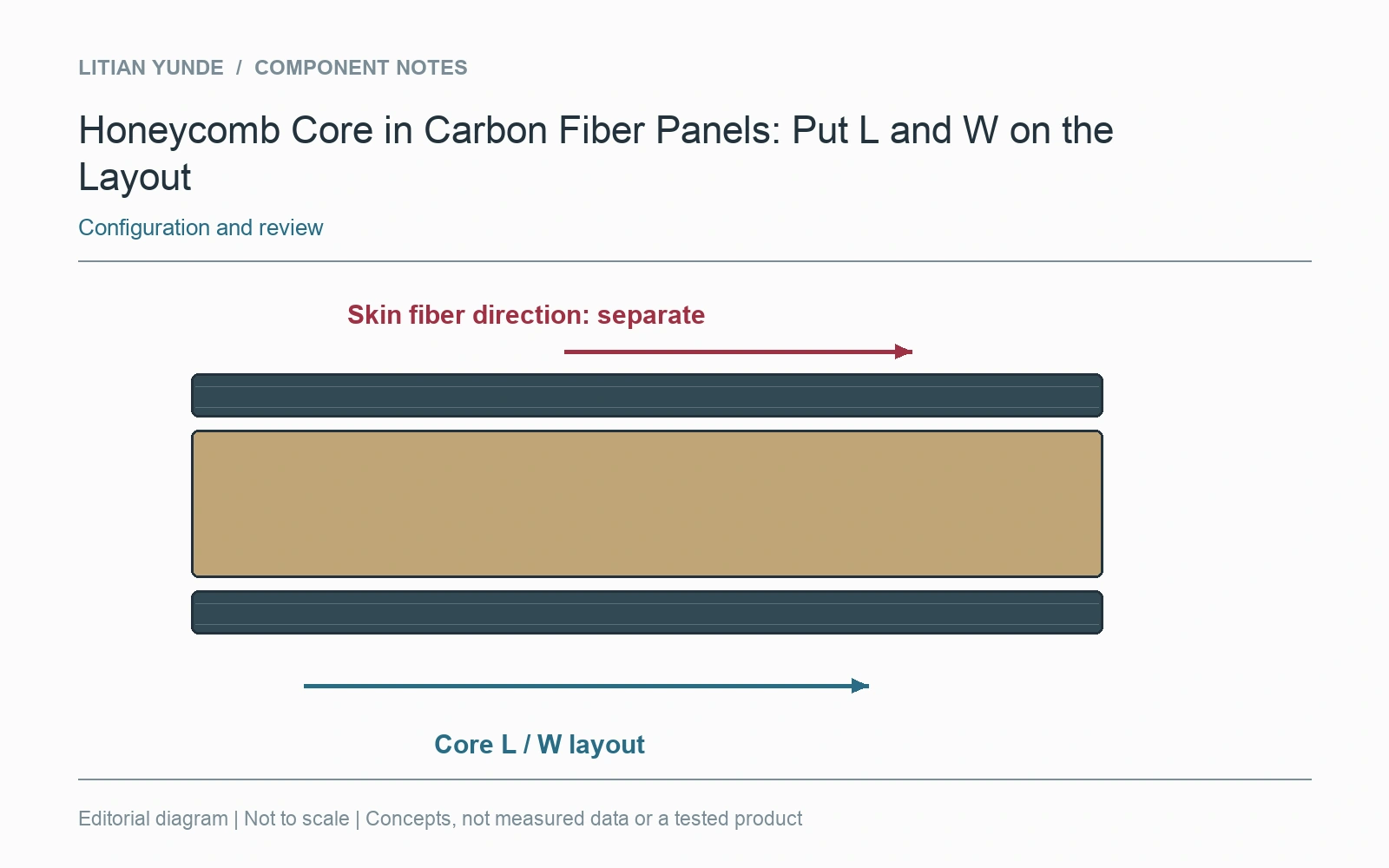
Honeycomb core has its own direction labels. Show how the supplier’s L, W and thickness directions relate to the carbon fiber panel drawing. Core density and cell size do not communicate that orientation, and the skin fiber direction is a separate part of the construction.
Use the core manufacturer’s convention
Hexcel’s honeycomb selector guide identifies L, W and thickness directions. Retain the convention used for the selected core product instead of guessing it from a small photograph of the cells. The required orientation belongs on the core layout or another controlled construction reference.
Relate the core to the panel axes
Mark the intended panel length and width alongside the core arrows. Include the orientation of separate core pieces if a panel contains more than one. Rotating a core blank to save material should remain a visible construction change when the orientation is specified.
Keep directional data attached
When a core datasheet lists directional properties, preserve their labels in the review. Do not transfer one column into a general claim for every panel direction. The completed sandwich also includes skins, joints and local features. A clear core layout supports the material discussion without substituting for the design and acceptance evidence of the finished panel.
Further reading: Hexcel: honeycomb configuration and direction labels.