

Symmetric and balanced describe different aspects of a laminate. Symmetry concerns the arrangement about the laminate mid-plane. Balance concerns matching positive and negative angle plies under the relevant material and thickness assumptions. One word does not automatically imply the other.
Read a stack from the mid-plane
A symmetric stack mirrors its material, thickness and orientation arrangement across the mid-plane. Repeating the same sequence on both halves is not necessarily the same as mirroring it. That distinction is easier to see in a section sketch than in a shorthand instruction such as “same layers each side”.
Check what the angle pair contains
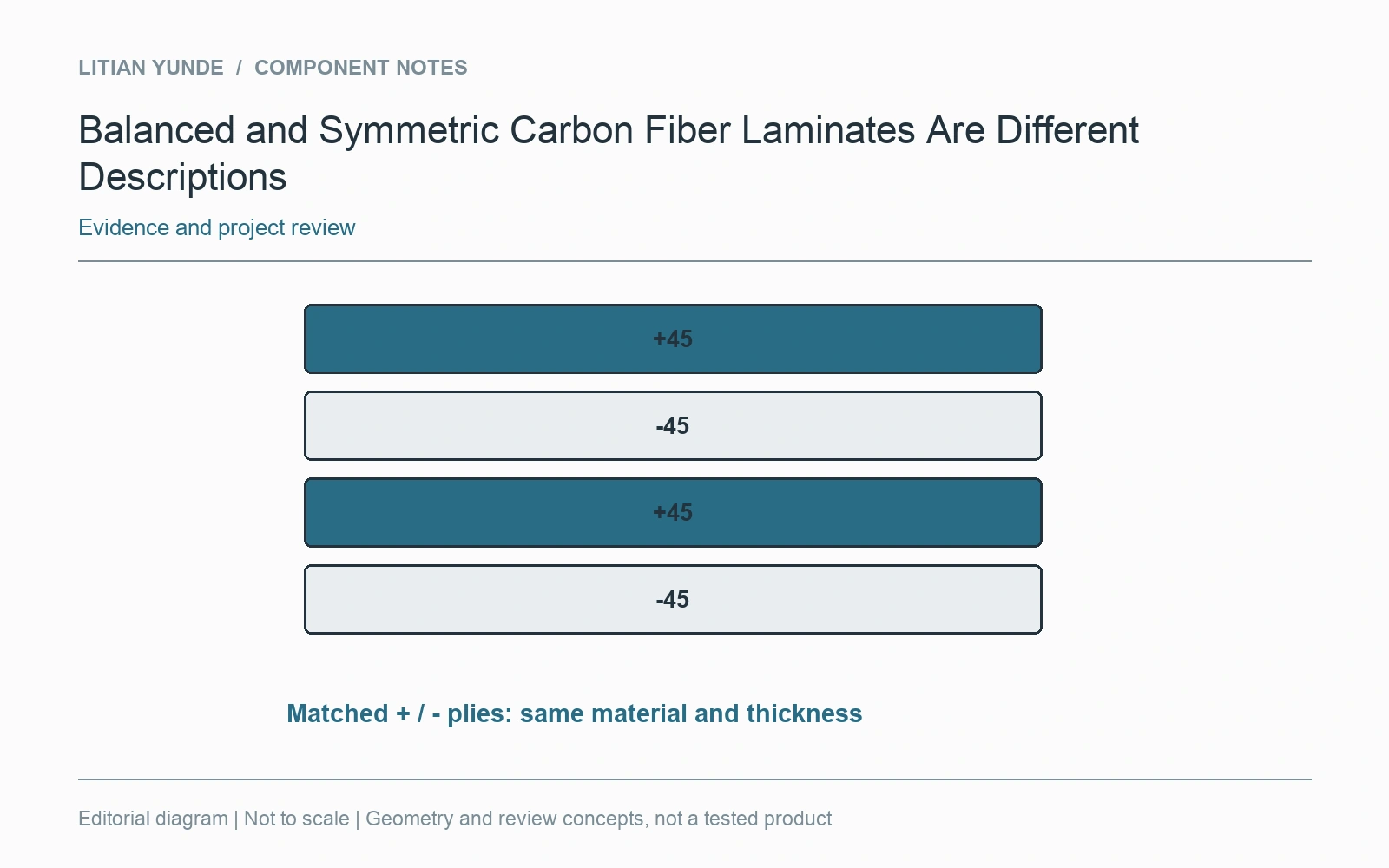
For the usual laminate-design meaning, a positive-angle ply is paired with a corresponding negative-angle ply of the same material and thickness. A similar-looking surface on both faces does not establish this condition. If woven materials or hybrid layers are involved, use the engineering definition appropriate to that construction rather than assuming a visual pattern proves balance.
A description still needs a design review
These terms help discuss laminate coupling and construction, but they are not acceptance shortcuts or a guarantee of flatness. Holes, local reinforcement, processing and the installed constraints still matter. Keep the complete stack, reference axes and any local departures on the controlled definition. If a supplier proposes a different sequence, review the actual change instead of accepting two familiar adjectives as evidence of equivalence.
Further reading: NASA: composite laminate design guidance.