
Tubes & Interfaces · Component review guide · Litian Yunde
The interface is more than bolt torque. Original explanatory schematic; not to scale and not a product test result.
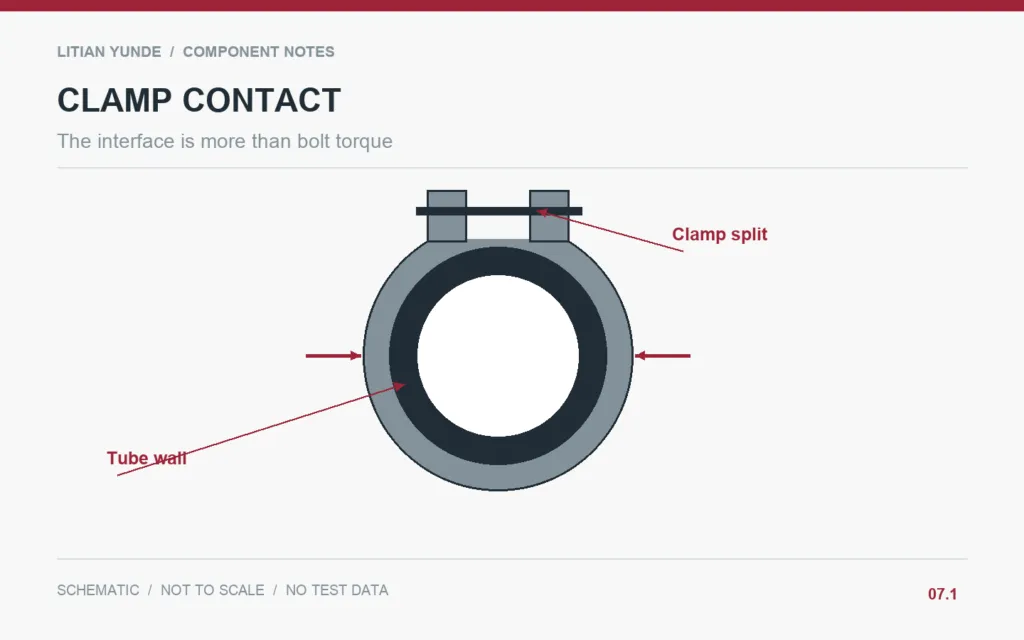
A carbon fiber tube clamp needs a defined contact geometry and an application-specific validation plan. Bolt torque alone does not describe contact pressure, slip resistance or the effect on the tube. Identify the clamp zone, hardware and tube construction before approving the assembly.
Show the clamp footprint
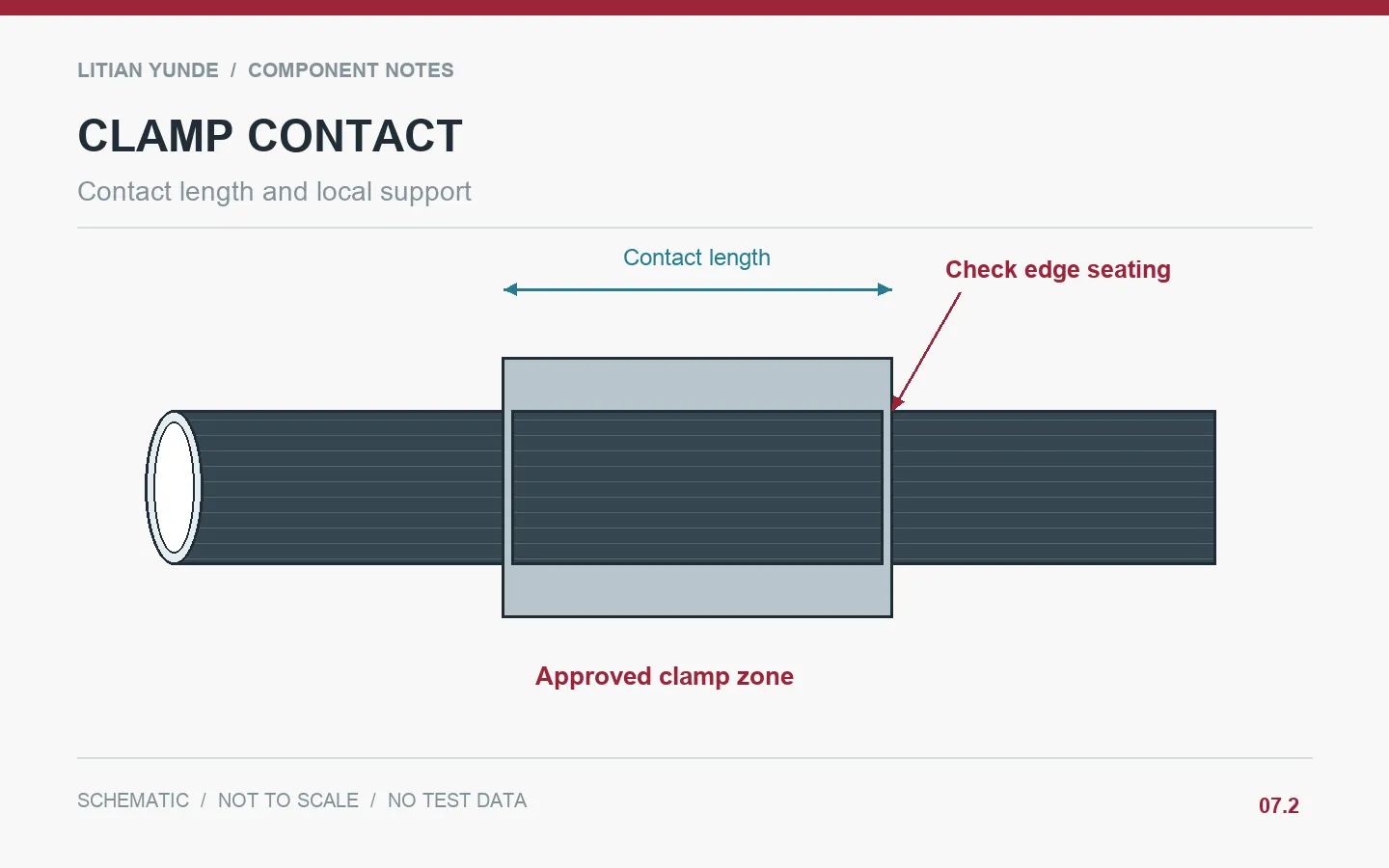
Specify the axial location, contact length, split arrangement and any liner or sleeve. Include adjacent features that might interfere with even seating. A clamp that touches only a narrow edge is not equivalent to one with the intended contact area. Do not infer an acceptable clamping load from the tube diameter or from a material datasheet alone.
Treat the hardware as part of the configuration
Record clamp material, fastener, lubrication condition and assembly instructions where relevant. Different hardware or contact surfaces can change the response at the same indicated torque. The responsible engineering team should establish the tightening and validation requirements. Avoid publishing a generic torque recommendation for an unspecified tube, particularly in a load-bearing or safety-related application.
Inspect retention and tube condition separately
Agree how the assembly is checked for movement and how the tube is examined after the prescribed test. A successful retention check does not establish that the laminate is undamaged. Define any additional inspection needed by the design authority. If the clamp will be repeatedly opened, include that duty in the review rather than accepting a one-time static fit as the complete requirement.
Example: a sensor bracket on an industrial tube
A bracket moves when adjusted even though the fastener has been tightened to the installer’s usual value. The team reviews clamp length, liner placement and tube support before changing the tightening instruction. A representative assembly is evaluated for retention and condition using an agreed procedure. The report identifies the full hardware configuration, not only the torque wrench setting.
Beispielszenario, kein Kundenfall und kein gemeldetes Produktionsergebnis.
Vor der Bestellung zu klärende Details
| Rezensionsobjekt | Zu Protokoll nehmen, um zuzustimmen |
|---|---|
| Contact geometry | Clamp length, split, edge radii and seating area. |
| Tube location | Permitted clamp zone and local construction reference. |
| Assembly method | Hardware, liner and approved tightening instruction. |
| Validation | Retention requirement, inspection and service cycles. |
Fragen, die Käufer stellen
Can I use the torque from a metal tube clamp?
Do not transfer it without reviewing and validating the composite assembly.
Does a soft liner guarantee protection?
No. The liner changes the interface but still needs evaluation with the tube and clamp.
Technischer Hintergrund und weiterführende Literatur
Hintergrundmaterial: Hexcel: Prepreg-Technologie. Die oben aufgeführte Projekt-Checkliste und das Beispiel dienen als redaktionelle Orientierungshilfe; diese Angabe stellt keine Zertifizierung einer Litian-Yunde-Komponente dar.
- Schnittstellen zwischen Kohlefaser und Metall: Was eine Angebotsanfrage enthalten sollte
- Telescoping Carbon Fiber Tubes: Specify Sliding Fit Across the Full Stroke
- Entdecken Sie das Wissenszentrum zum Thema Kohlefaser
Besprechen Sie Ihre Komponente mit Litian Yunde
Teilen Sie uns die überarbeitete Zeichnung, den vorgesehenen Einsatzzweck sowie die Frage zur Schnittstelle oder zur Abnahme mit, die Sie klären möchten. Die angegebenen Konstruktions- und Abnahmeanforderungen sind für das jeweilige Projekt bestätigt.